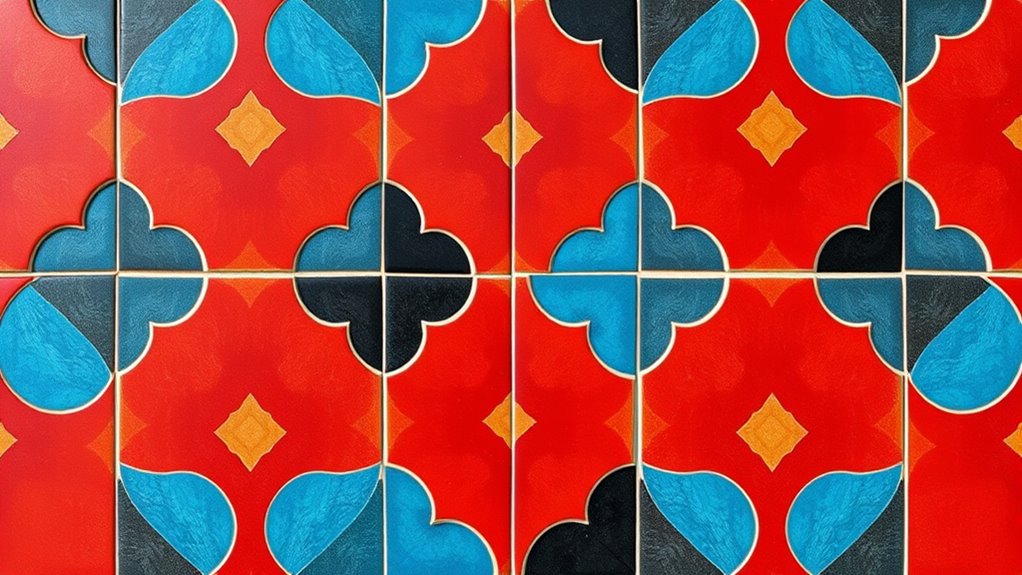

To convert pattern repeats to fit your wall, start by measuring your wall’s width and height accurately. Determine the pattern’s original repeat size and divide the wall width by this measurement to find out how many repeats you need. If it doesn’t fit perfectly, you can scale up or down the pattern proportionally while maintaining its aspect ratio. Fine-tuning these calculations guarantees seamless alignment and minimal waste—keep going to learn the detailed steps involved.
Key Takeaways
- Measure the wall dimensions and pattern repeat size accurately to determine how many repeats are needed.
- Divide wall width by pattern repeat to find the number of full repeats required for seamless coverage.
- Adjust the pattern scale proportionally if repeats don’t fit evenly, using image editing or printing techniques.
- Recalculate the pattern repeats after scaling to ensure proper alignment and minimize waste.
- Plan layout carefully to align pattern joins seamlessly, considering scaled repeats and wall measurements.
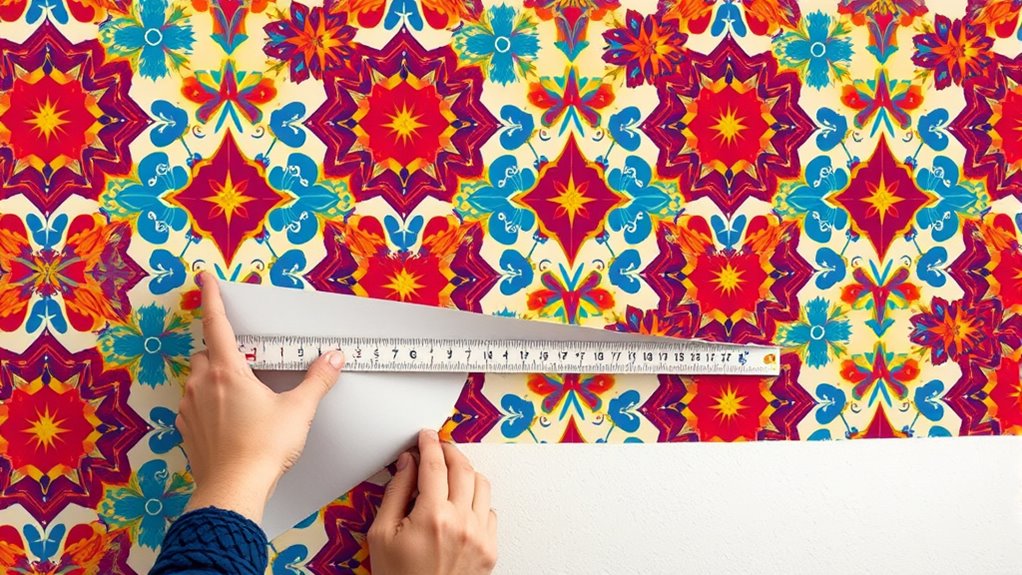
When working with patterned wallpaper or tiles, you often need to adjust a repeating design to fit a specific wall size. This process involves understanding how the pattern’s scale relates to your measurements and using measurement techniques to guarantee a seamless fit. The key is to manipulate the pattern scale—either enlarging or reducing it—so the repeated design aligns perfectly with your wall dimensions without awkward cuts or mismatched joins.
First, you need to determine the wall’s measurements precisely. Measure the height and width of the wall, noting any irregularities or architectural features that might affect the pattern placement. Once you have these measurements, you’ll compare them to the pattern’s original repeat size. Pattern repeats are usually specified in inches or centimeters and indicate how often the pattern repeats itself horizontally and vertically. Knowing this, you can calculate how many repeats fit into your wall dimensions and plan how to adjust the pattern scale accordingly.
Measure your wall carefully to plan seamless pattern placement and scaling.
To do this, you employ measurement techniques that involve dividing your wall measurements by the pattern’s original repeat size. For example, if your wall is 120 inches wide and the pattern’s horizontal repeat is 24 inches, dividing 120 by 24 gives you five repeats across the wall. If this doesn’t produce a clean number or results in awkward leftover space, you might decide to scale the pattern up or down. By adjusting the pattern scale, you can guarantee the pattern repeats evenly without partial repeats or mismatched lines.
Pattern scale adjustments typically involve proportionally enlarging or reducing the pattern using image editing software or printing techniques. If you’re working with digital files, you can resize the pattern while maintaining its aspect ratio. For physical applications, some wallpaper manufacturers offer scaled samples or custom printing options. When you scale a pattern, you’ll need to recalculate the number of repeats that will fit across your wall, ensuring the final layout aligns smoothly from one edge to the other. This process is similar to Volkswagen Tuning, where precise adjustments optimize performance and fit.
Using measurement techniques combined with a clear understanding of pattern scale makes this process manageable. It allows you to plan the layout carefully, minimizing waste and reducing errors. Remember, precision in measurement and thoughtful adjustment of pattern scale are vital for achieving a professional, polished look. By mastering these skills, you’ll be able to adapt any repeating design to fit any wall size, no matter how complex the pattern or dimensions might be. This approach ensures your wallpaper or tile installation looks seamless, harmonious, and visually appealing.
Frequently Asked Questions
How Do I Adjust Pattern Repeats for Uneven Wall Surfaces?
To adjust pattern repeats for uneven wall surfaces, start by measuring irregular surfaces carefully, noting any dips or bumps. Use pattern distortion techniques, like stretching or shrinking sections of the design, to guarantee the pattern aligns smoothly across the surface. Apply these adjustments during installation, frequently checking measurements to prevent gaps or overlaps. This approach helps create a seamless look despite the wall’s unevenness, giving your project a professional finish.
What Tools Are Best for Measuring Pattern Repeats Accurately?
You’re on the right track by asking about tools for measuring pattern repeats. To get accurate measurements, use a reliable measuring tape for length and pattern rulers for detailed repeat spacing. These tools are your bread and butter, helping you avoid any guesswork. Keep them close, and you’ll find it’s a piece of cake to match patterns perfectly—just don’t forget to double-check your measurements before cutting.
Can Pattern Math Be Used for Irregularly Shaped Walls?
Yes, you can use pattern math for irregularly shaped walls by applying digital patterning and geometric calculations. First, measure the wall’s unique dimensions carefully. Then, use digital tools to create a scaled version of your pattern, adjusting for curves or angles. This approach helps you visualize how the pattern will fit, ensuring seamless coverage despite irregular shapes. It’s a smart way to customize your design accurately.
How Do I Handle Pattern Alignment at Corners or Edges?
Think of edge matching like a vintage typewriter, where every letter aligns perfectly. To handle pattern alignment at corners or edges, you should carefully measure and mark your pattern pieces, ensuring seamless connectivity. Focus on precise corner alignment and consistent edge matching, adjusting your pattern as needed. Use spacers or templates for tricky corners, and double-check your work before sticking to avoid misalignment, making your design look professional.
What Are Common Mistakes to Avoid When Converting Repeats?
To avoid pattern distortion and repeat misalignment, double-check your measurements and mark the wall accurately before cutting. Don’t rush the process—take your time to align the pattern precisely at seams and edges. Avoid stretching or pulling the wallpaper during application, as this causes distortion. Also, make certain your pattern repeats match up correctly across panels, or you’ll end up with uneven, misaligned designs that ruin the overall look.
Conclusion
By mastering how to convert repeats to fit a wall, you guarantee your pattern looks seamless and professional. You might worry it’s too complex or time-consuming, but with a few simple calculations, it becomes manageable. Remember, patience and careful measurement are your best tools. Once you grasp the pattern math, you’ll confidently create stunning, perfectly aligned designs that elevate your space. So, embrace the challenge—your beautiful, custom-fitted wall awaits!