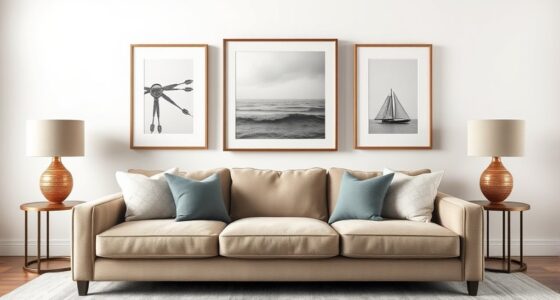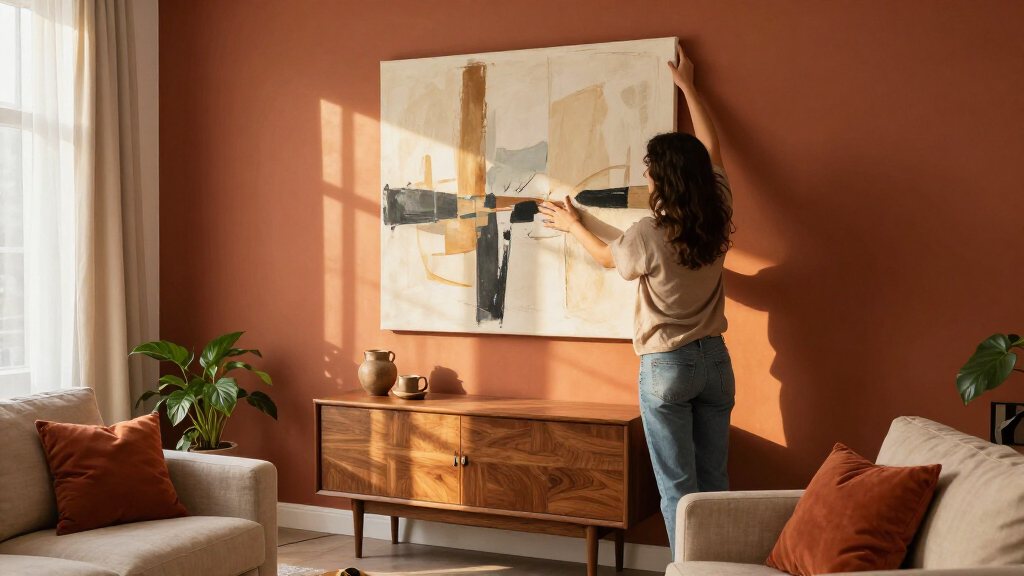

When most people set out to buy modern wall art for a living room, the first real fork in the road is not the image itself but the format it comes in: a canvas print, stretched over a wooden frame with no glazing, or a framed print, a paper print mounted behind glass or acrylic inside a moulding. Both formats can carry the same photograph, abstract composition, or line drawing, yet the finished result on your wall looks and behaves very differently.

Get furniture and decor delivered free with Prime
- Fast, free delivery on millions of items
- Prime Video, Amazon Music and more included
- Member-only deals all year

Thalasse 3-Piece 3D Textured Wall Art, 24 × 36 Inches
- ✔ Set size: 3 panels
- ✔ Panel dimensions: 24 × 36 inches (60 × 90 cm) each
- ✔ Relief depth: Over 2 cm

Muolunna Tropical Beach Seascape Framed Canvas Wall Art, 20 x 40 Inches
- ✔ Brand: Muolunna
- ✔ Model: BK6750
- ✔ Dimensions: 40 x 20 inches

MXUNYZ Minimalist Blue and Brown Abstract Canvas Wall Art, 24 x 48 Inch
- ✔ Brand: MXUNYZ
- ✔ Dimensions: 48 x 24 inches
- ✔ Color: Blue and brown
The decision tension is real. Canvas prints dominate mid-century, Scandinavian, and contemporary interiors because the frameless wrap reads as relaxed and current, and they cost noticeably less at large sizes. Framed prints — whether a slim black frame around a photographic print or a float frame around a giclée — carry more visual authority, protect the artwork from dust, moisture, and UV, and let you swap mats and mouldings to match evolving décor. The main tradeoff is cost and lightness versus polish and protection.
This guide compares the two formats head-to-head across the criteria that actually drive living-room decisions: price, visual style, durability, size flexibility, maintenance, installation, and long-term flexibility. If your priority is a big, modern statement on a budget, canvas is hard to beat. If you want a piece that will look intentional for a decade and survive sunlight, kids, and humidity, framing earns its premium. Here is how the two stack up.
At a Glance
| Criteria | Canvas Prints | Framed Prints (Under Glass/Acrylic) | Winner |
|---|---|---|---|
| Price at large sizes | Low — often 40–60% cheaper than equivalent framed size | Higher — print plus frame, mat, and glazing costs add up fast | A |
| Modern style fit | Excellent for contemporary, Scandinavian, mid-century, boho interiors | Strong for gallery, traditional, eclectic, and minimalist-with-edges interiors | Depends |
| Durability & protection | Exposed surface; can dent, scratch, warp in humidity; no UV shield | Glass/acrylic shields against dust, moisture, UV; archival options available | B |
| Maintenance | Dust with dry cloth; cannot wipe with liquids | Clean glass easily; artwork itself untouched | B |
| Weight & installation | Very light; hangs from one screw or nail; wire-free | Heavier, especially with glass at large sizes; needs solid anchors | A |
| Size & customization flexibility | Strong — common up to 60+ inches; edge-wrap and split options | Broad — any size, mat styles, moulding colors, glare/museum glazing | B |
| Long-term décor adaptability | Limited — printed edges are fixed; look can feel dated if trends shift | Excellent — swap frame or mat to refresh without replacing the art | B |
| Perceived quality / resale value | Casual; low perceived value at entry level | Higher; looks like collected art rather than purchased décor | B |
Thalasse 3-Piece 3D Textured Wall Art, 24 × 36 Inches
This option stands out for doing something neither canvas print in this lineup can: it occupies real physical space on the wall. With a relief depth of over 2 cm, the geometric panels cast shadows that shift as daylight moves across the room, so the artwork effectively changes character from morning to evening. Compared with the Muolunna seascape, which communicates entirely through printed color, the Thalasse set delivers depth through form and texture — a matte, sandstone-like surface that keeps glare to a minimum even in bright, south-facing living rooms.The construction also justifies the top spot. Each 24 × 36 inch panel sits in a solid Catalpa wood frame with a walnut finish, giving the set a finished profile from every angle — no bare canvas edges as with a wrapped print. The pale sand beige tone is deliberately understated, which makes this the safest choice for buyers decorating around a neutral, Wabi-Sabi, or minimalist scheme. The tradeoff is logistical rather than aesthetic: three large panels require substantial wall space and careful alignment, and the listing does not specify mounting hardware, so you may need to supply your own anchors. For a single accent wall above a long sofa, though, this set makes the strongest statement of the three.
Pros:
- Over 2 cm of relief depth creates shifting shadows and genuine dimensional interest
- Matte sandstone surface reduces glare in bright rooms
- Solid Catalpa wood frames with walnut finish look finished from all angles
- Three panels cover a broad wall area for a cohesive gallery-style effect
Cons:
- Requires substantial wall space and precise panel alignment
- Mounting hardware and installation details are not specified
Best for: Homeowners with a large, neutral-toned living room wall who want sculptural, light-reactive art rather than a flat print.
Not ideal for: Renters or anyone with limited wall space, or buyers who want bold color — this set is intentionally quiet in tone.
Bottom line: The most architecturally interesting piece in this roundup — pick it if your living room has the wall space to let the texture breathe.
“The most architecturally interesting piece in this roundup — pick it if your living room has the wall space to let the texture breathe.”
Muolunna Tropical Beach Seascape Framed Canvas Wall Art, 20 x 40 Inches
Where the Thalasse set works through texture, the Muolunna seascape works through atmosphere. Its 40 × 20 inch horizontal format of turquoise water and white clouds is built to sit above a sofa or console, and the wide landscape orientation makes a modest wall feel more expansive — something the taller, narrower MXUNYZ canvas cannot do as effectively. Compared with the MXUNYZ, this print is also the more practical daily performer: the canvas surface is waterproof and wipeable, so it shrugs off the dust and occasional splashes that living rooms produce.Fade-resistant inks mean the blue tones should hold up in sunlit spaces, which matters because a seascape loses its appeal the moment the water reads gray instead of turquoise. The pre-installed metal hooks also make this the easiest installation in the lineup — one panel, one hanging point, no alignment math. The honest limitations: it is indoor-only, so it will not survive a covered porch, and as a single flat canvas it adds no dimensional depth. If your decor leans coastal, breezy, or blue-forward, this is the clear pick; if your room already runs cool in tone, the brown accents of the MXUNYZ will warm the space more effectively.
Pros:
- Fade-resistant inks preserve the turquoise palette in sunlit rooms
- Waterproof, wipeable canvas surface simplifies cleaning
- Wooden frame and pre-installed hooks make hanging straightforward
- Wide landscape format suits sofa walls and open-concept spaces
Cons:
- Indoor use only
- Flat canvas offers none of the dimensional depth of sculptural alternatives
Best for: Buyers decorating a coastal, Hamptons, or light-toned living room who want a wide, calming focal piece with minimal installation fuss.
Not ideal for: Warm or earthy interiors where another cool blue element would feel repetitive, or anyone wanting dimensional texture.
Bottom line: The most livable and low-effort choice here — best for bright, coastal-style living rooms where color sets the mood.
“The most livable and low-effort choice here — best for bright, coastal-style living rooms where color sets the mood.”
MXUNYZ Minimalist Blue and Brown Abstract Canvas Wall Art, 24 x 48 Inch
The MXUNYZ abstract canvas earns its place by solving a specific color problem: many modern living rooms are already full of cool grays and blues, and what they need is a piece that bridges cool and warm tones. The teal-and-brown palette does exactly that, grounding a neutral room without introducing a literal scene, unlike the Muolunna seascape. This makes it the strongest pick for buyers who want abstract, mood-driven art rather than a landscape with a defined subject.In terms of practicality, it sits between the other two. It arrives stretched on a wooden frame with hanging hardware included, so installation is nearly as simple as the Muolunna — far less involved than aligning the three Thalasse panels. Maintenance is minimal too, with dry-cloth dusting and fade-resistant inks for longevity. The drawbacks are worth weighing honestly: it is indoor-only, and the listing does not specify alternative size options, so you are committing to a single 48 × 24 inch format. Compared with the Thalasse, it sacrifices depth and wall coverage; compared with the Muolunna, it trades easy-clean waterproofing for a warmer, more versatile palette. For a bedroom-adjacent living space or a hallway-adjacent accent wall in an earthy modern home, that trade is well worth it.
Pros:
- Teal and brown palette bridges cool and warm tones for versatile pairing
- Wooden frame and included hanging hardware simplify installation
- Fade-resistant inks support long-term display
- Abstract subject suits minimalist, Japandi, and contemporary schemes
Cons:
- Indoor use only
- Available size options are not specified
- Single flat canvas provides less wall coverage than the three-panel set
Best for: Buyers with warm, minimalist, or Japandi-leaning living rooms who want abstract color that bridges cool and earthy tones.
Not ideal for: Coastal or blue-forward rooms that need cooling down, or buyers who need multiple size options.
Bottom line: The best color-bridging option of the three — choose it when your living room needs warmth and calm rather than a scene or sculpture.
“The best color-bridging option of the three — choose it when your living room needs warmth and calm rather than a scene or sculpture.”
As an Amazon Associate we earn from qualifying purchases.
Key Differences
The single biggest practical difference is what sits between your artwork and your living room. A canvas print is the artwork: ink on fabric stretched over pine bars, fully exposed to the air. A framed print is the artwork plus a protective layer plus a decorative border. That one structural fact drives nearly everything else — price, weight, longevity, and how formal the wall feels.
Second, the formats signal different things stylistically. Canvas reads as relaxed, contemporary, and accessible — it is the default choice for oversized abstracts, family photos, and photo walls precisely because it disappears into a modern room. Framed prints read as deliberate and curated. A matted print in a thin frame looks like something you chose; a large canvas can sometimes look like something you ordered. Neither is wrong, but they set different tones in the same room.
Third, the economics diverge sharply with size. At 16×20 inches the price gap is modest; at 40×60 inches it can be hundreds of dollars, because framing large pieces requires oversized glazing, sturdy moulding, and professional assembly. That is why gallery walls of framed pieces usually mix small sizes, while statement walls over sofas lean canvas. Budget and wall size, more than taste alone, often settle this decision.
Detailed Comparison
Price at large sizes (Canvas Prints wins — major)
Canvas wins this decisively, and the gap widens with scale. A 36×48-inch canvas from a reputable online printer typically costs a fraction of a custom-framed print at the same size, because there is no glazing, mat, moulding, or assembly labor. Framing costs are driven by perimeter and glazing area — doubling dimensions can more than double the price. For a living room where the art sits above a sofa or fireplace and needs to fill a 50+ inch wall span, canvas delivers the most visual impact per dollar in modern wall art. Framed prints only make financial sense at large sizes when the piece itself is valuable or archival.
Modern style fit (moderate difference)
This depends on which flavor of “modern” your living room leans toward. Canvas is the natural fit for Scandinavian, boho, mid-century, and loft-style spaces — the frameless wrap suits low, casual furniture and neutral palettes. Framed prints suit gallery-style, minimalist, transitional, and eclectic interiors, where the frame acts as punctuation. A thin black or oak frame around a large photographic print is arguably the most current look in high-end interiors right now. Verdict: canvas fits casual modern better; framed fits refined modern better. Assess your room’s formality honestly before choosing.
Durability and protection (Framed Prints (Under Glass/Acrylic) wins — major)
Framed prints win clearly. Glass or acrylic shields the paper surface from dust, fingerprints, cooking grease, and UV fading, and museum glazing blocks most light damage for decades. Canvas has no shield: the printed surface can be dented by a thrown toy, scratched during moving, warped by humidity near kitchens or poorly ventilated rooms, and fades faster in direct sun. If your living room gets strong afternoon light or your household includes children and pets, the protective gap matters. Canvases can be treated with UV-protective sprays, which narrows but does not close the gap.
Maintenance (Framed Prints (Under Glass/Acrylic) wins — moderate)
A framed print under glass is the lowest-touch option: wipe the glazing with glass cleaner occasionally and the artwork itself never needs attention. Canvas must be dusted dry — liquids can smear the ink or stain the fabric — and once soiled or scuffed, there is no practical way to clean or restore it. In a living room, where soft furnishings shed fibers and kitchens share air, glass stays newer-looking longer. This is a moderate gap: neither is high-maintenance, but one forgives real life better.
Weight and installation (Canvas Prints wins — moderate)
Canvas is dramatically easier to hang. A large stretched canvas weighs a few pounds, hangs from a single nail or screw, and can be repositioned by one person in minutes — useful when you are still deciding on wall placement. A framed 30×40-inch print with glass can be heavy enough to require two people, wall anchors, and careful leveling, and acrylic glazing (lighter but pricier) is often needed at large sizes. If you rent, redecorate often, or build your wall gradually, canvas is far more forgiving.
Size and customization flexibility (Framed Prints (Under Glass/Acrylic) wins — moderate)
Both formats scale well, but framed prints offer far more configuration: mat widths, mat colors, moulding profiles and finishes, glazing types (standard, non-glare, museum), and float-mounting. Canvas offers fewer variables — edge wrap style, depth of stretcher bars, and occasionally hand embellishment. Framing also allows you to re-frame the same print later; a canvas cannot be reframed without a costly transfer. Winner is framed, though the practical advantage only matters to buyers who care about matching frames across a collection.
Long-term décor adaptability (Framed Prints (Under Glass/Acrylic) wins — moderate)
A framed print ages with your room: swap the frame from black to oak when your palette shifts, and the same artwork stays current. Canvas is fixed — the printed edge wrap and mounting are what they are, and if the piece begins to feel dated, the only option is replacement. For buyers who redecorate every few years or invest in individual pieces they expect to keep, framing protects that investment. For buyers who refresh walls casually and often, replaceability is a feature, not a flaw, and canvas’s low cost makes swapping painless.
Perceived quality (Framed Prints (Under Glass/Acrylic) wins — minor)
Framed prints read as collected art; canvases read as purchased décor. This is partly unfair — a well-printed canvas on a quality stretcher can look superb — but the mat and frame genuinely elevate perceived craftsmanship, especially at eye level in a main living space. Entry-level canvases with visible bar outlines under thin fabric or washed-out color reinforce the budget impression. If guests’ impressions matter to you, or you are styling a formal living room, framed wins. In a family room or casual space, most visitors will never register the difference.
Canvas Prints: Pros and Cons
Pros:
- Lowest cost per square inch, especially at statement sizes above 36 inches
- Lightweight and easy to hang, move, and reposition single-handedly
- Frameless look fits effortlessly into contemporary and casual interiors
- Simple, clean presentation with no frame to match to furniture or trim
- Widely available with fast turnaround from online printers
Cons:
- Exposed surface is vulnerable to dents, scratches, moisture, and fading
- Cannot be cleaned with liquids; damage is effectively permanent
- Cannot be reframed or restyled — replacement is the only refresh path
- Entry-level versions can look and feel cheap at close range
- Warping risk in humid rooms or over radiators
Framed Prints (Under Glass/Acrylic): Pros and Cons
Pros:
- Glazing protects against dust, moisture, UV, and physical damage
- Frame and mat can be changed to match evolving décor
- Higher perceived quality and gallery-like finish
- Archival paper and museum glazing options preserve art for decades
- Extensive customization of moulding, mats, and glazing types
Cons:
- Substantially more expensive, and costs multiply at large sizes
- Heavier and harder to hang, often needing anchors or two people
- Glass can produce glare opposite windows (non-glare glazing costs extra)
- Frame styles can date or clash with surrounding finishes
- More decisions required — mat, moulding, glazing — which slows buying
Who Should Choose What
Choose Canvas Prints if:
- You need to fill a large wall (48 inches or wider) above a sofa or fireplace without a large budget
- Your living room leans casual — Scandinavian, boho, mid-century, or family-friendly
- You rent or redecorate often and want art that is cheap to hang, move, and replace
- You are building a photo wall or multi-piece arrangement where cost per piece adds up
- The wall gets low traffic and indirect light, so canvas’s vulnerability is a non-issue
Choose Framed Prints (Under Glass/Acrylic) if:
- You are buying one or two statement pieces you intend to keep for many years
- The living room is formal or design-forward and perceived quality matters to you
- The wall receives direct sunlight or the room is humid, and you want UV and moisture protection
- You want to match frames across a collection or coordinate with existing trim and furniture
- The artwork itself is valuable, limited-edition, or archival and deserves protection
Skip both if: Your wall is very small, awkwardly lit, or still undecided stylistically — in that case, live with the space for a few weeks before buying anything, or start with inexpensive prints on shelves rather than committing to either wall-mounted format.
Value for Money
Value in modern wall art is mostly a question of cost per year of satisfaction, not sticker price. Canvas is unambiguously the better value if you want maximum size and impact per dollar and accept a five-to-ten-year lifespan in normal conditions. A $120 canvas that anchors your living room for eight years is excellent value even if it ends up replaced.
Framed prints pay off differently. Paying two to three times more buys physical protection, style flexibility, and a finish that holds up visually for decades — but only if you actually keep and display the piece that long. Framing a trendy $40 print expensively is poor value; the frame outlives the artwork’s relevance. The best framing investments are pieces with lasting personal meaning: wedding photographs, travel images, original works, limited editions.
A practical middle path many living rooms benefit from: large canvases for the big statement wall, framed prints for smaller, eye-level pieces in seating areas where guests look closely. That split captures most of each format’s strengths and contains the cost of the expensive one.
Final Verdict
For the majority of buyers shopping for modern living room wall art, canvas prints are the smarter default: they deliver the oversized, contemporary look that defines current living-room styling at a price that makes experimenting painless, and they install in minutes. If your goal is a bold wall above the sofa on a realistic budget, choose canvas without hesitation.
Choose framed prints when the piece matters more than the wall — when you are buying art to keep for a decade, when the room is formal enough that a bare canvas looks underdressed, or when sunlight and humidity make protection a genuine concern. The premium buys durability and polish, and for long-term display it is money well spent; for disposable trend décor it is not.
The single biggest deciding factor is wall size paired with budget: above roughly 40 inches, canvas’s price advantage usually settles the question; below it, and for pieces you intend to keep, the frame earns its cost. If your budget allows both, mix them — a large canvas statement with framed pieces at eye level is the combination most professional stylists land on.
Frequently Asked Questions
Do canvas prints look cheap compared to framed prints?
They can, but only at the entry level. A canvas from a quality printer with thick stretcher bars (1.5 inches or more) and accurate color reproduction looks distinctly modern rather than cheap. What reads as cheap is thin fabric showing bar outlines, washed-out color, or a sagging surface. A well-made large canvas in a casual contemporary room looks intentional; the same room with a formal frame can look overdone. Match the format to the room’s formality.
Which format handles sunlight better in a living room?
Framed prints with UV-filtering glazing protect the artwork far better and should be the choice for walls that receive direct sun for hours each day. Canvas fades faster under UV exposure, though a protective spray slows the process. For bright south- or west-facing living rooms, either choose framing or rotate the artwork periodically.
Can I hang a large framed print alone?
Up to roughly 24×36 inches with acrylic glazing, yes — one careful person with a level can manage it. Beyond that, especially with glass, expect 15–30 pounds or more and get help. Large canvases, by contrast, almost always hang solo with a single nail or screw, which is a real advantage while you are still deciding on placement.
Is it worth paying extra for custom framing versus buying a pre-framed print?
Pre-framed prints (frame included at purchase) are the best value in the framed category — the manufacturer buys frames at scale and passes on the savings. Custom framing is worth it only when matching existing frames, fitting an unusual size, or protecting a valuable piece. If you simply want the framed look, buy pre-framed and skip the frame shop.
How do I decide the right size for a living room wall?
A common guideline: the artwork should span roughly two-thirds to three-quarters of the width of the furniture below it (a sofa, console, or fireplace). Above a 84-inch sofa, that means art or an arrangement 50–60 inches wide. This is where canvas’s size-for-price advantage becomes decisive — large framed pieces at that span get expensive quickly, which is why oversized canvases dominate statement walls.
Fall Picks
fall essentials
As an affiliate, we earn on qualifying purchases.