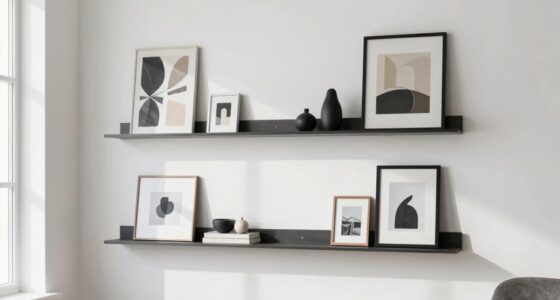
When your picture light has a narrow beam, it often results in uneven illumination, harsh shadows, and incomplete coverage of your artwork. Narrow beams focus light into a small, intense circle, leaving other areas in shadow and failing to highlight the whole piece. The fixture’s placement and bulb choice also play a role in how well the light disperses. Keep in mind, adjusting these factors can make a big difference in achieving even, balanced lighting—there’s more to learn on how to improve your setup.

Get furniture and decor delivered free — and shop member deals
- Fast, free delivery on millions of items
- Access to Prime Big Deal Days deals on October 6–7
- Prime Video, Amazon Music and more included
Key Takeaways
- Narrow beams create uneven lighting, leaving parts of the artwork in shadow or underlit.
- Focused fixtures with small reflectors concentrate light, failing to evenly illuminate the entire piece.
- Positioning fixtures too close or at steep angles intensifies the narrow beam effect.
- Using bulbs with a narrow focus exacerbates uneven coverage and harsh shadows.
- Poor fixture placement and inadequate dispersal reduce the effectiveness of picture lighting.

If your picture lights cast a narrow, focused beam that doesn’t illuminate the entire artwork, you’re not alone. Many people encounter this issue because of how artificial lighting interacts with the fixture design and the way the light is distributed. Narrow beams are often a result of fixtures that are intentionally designed to highlight specific details, but when used on larger or more complex pieces, they fall short of providing even coverage. This is a common problem caused by the way the fixture’s shape and bulb type concentrate the light into a tight circle, leaving the edges of your artwork in shadow.
The core of the problem lies in fixture design. Some picture lights are built with small, focused reflectors or narrow beam angles, which are excellent for accent lighting but less effective for general illumination. When you select a fixture with a limited beam spread, it’s like shining a flashlight directly at a small spot rather than flooding the entire surface. This narrow beam can create uneven lighting, making parts of your artwork appear dim or obscured. To fix this, you need to choose fixtures with wider beam angles, which spread the light more evenly across the entire piece.
Artificial lighting, especially when poorly chosen or positioned, can also accentuate the problem. Incandescent bulbs, LED bulbs, or halogen bulbs all have different characteristics, but many are designed with a narrow focus intentionally. If you’re using a bulb that produces a concentrated light, it contributes to the narrow beam problem. The solution is to opt for bulbs with wider beam spreads or diffusers that soften and disperse the light more broadly. By doing this, you allow the light to flow across the surface of your artwork, eliminating harsh shadows and creating a more natural, balanced appearance.
Another factor is the height and angle at which you position the fixture. Even with the right fixture design and bulb choice, if the light is directed too closely or at a steep angle, it will create a concentrated, narrow beam. Moving the light slightly farther from the artwork and angling it more broadly can help distribute the light evenly. Experimenting with different fixture placements ensures you’re not just highlighting a small area but truly illuminating the entire piece.
Additionally, understanding the importance of lighting distribution can help you make better choices for your setup. In short, narrow beams are often a mismatch between fixture design and the requirements of proper illumination. Choosing fixtures with wider beam angles, selecting bulbs designed for broader dispersal, and adjusting placement can make all the difference. When you pay attention to these factors, your artwork will be evenly lit, vibrant, and beautifully showcased, rather than lost in shadows cast by a narrow, focused light.
As an affiliate, we earn on qualifying purchases.
Frequently Asked Questions
Can Adjusting the Bulb Size Fix a Narrow Beam?
Yes, adjusting the bulb size can fix a narrow beam, but it depends on bulb compatibility and beam angle. Choose bulbs with a wider beam angle designed for your picture light fixture. Make certain the new bulb fits properly and matches the fixture’s specifications. By selecting the right bulb size and angle, you can improve the light spread, making your artwork more evenly illuminated and visually appealing.
Are There Specific Brands Known for Wider Beam Picture Lights?
Yes, some brands are known for wider beam picture lights, offering vintage styles and modern designs that suit various decor. You should look into brands like Hudson Valley, Kichler, and Design House, which often design fixtures with broader light spreads. These brands focus on quality and innovative designs, ensuring you get a wider, more even illumination. This makes your artwork stand out without harsh shadows or narrow beams.
How Does the Mounting Height Affect Beam Width?
Imagine your picture light as a lighthouse; the mounting height is its tower, and the beam angle is the lighthouse’s glow. When you mount it higher, the beam widens, illuminating more of your artwork. Lower mounting height narrows the beam, focusing light tightly. Adjusting the mounting height directly influences the beam width, helping you achieve the perfect spread for your art.
Do LED Picture Lights Have Different Beam Spread Options?
Yes, LED picture lights often come with different beam spread options. You can choose narrow, medium, or wide beams depending on your display’s size and the desired lighting effect. These options allow you to control the light’s focus and spread, enhancing your artwork’s color temperature and ensuring energy efficiency. Selecting the right beam spread helps prevent glare and shadows, ensuring your artwork is beautifully illuminated without wasting energy.
Is Professional Installation Necessary for Optimal Beam Coverage?
You don’t need a professional for perfect beam coverage, but it’s highly recommended for art installation. A professional guarantees beam consistency, preventing shadows or overly narrow spreads that can ruin your display. Without expert help, you might struggle with uneven lighting that’s as frustrating as chasing shadows. A skilled installer guarantees your picture light’s beam hits the mark, showcasing your art beautifully and making your space look truly spectacular.
adjustable picture light fixture
As an affiliate, we earn on qualifying purchases.
As an affiliate, we earn on qualifying purchases.
Conclusion
So, next time your picture light seems more like a spotlight, remember it’s not the artwork’s fault. Instead, the narrow beam is silently sabotaging your display, leaving your masterpiece in shadows. It’s ironic how a tiny adjustment can turn a dull glow into a warm embrace. Don’t let a simple beam angle steal the spotlight—embrace the change and watch your art finally shine as brightly as you imagined.
As an affiliate, we earn on qualifying purchases.
artwork lighting with wide beam angle
As an affiliate, we earn on qualifying purchases.
As an affiliate, we earn on qualifying purchases.
Halloween Picks
halloween
As an affiliate, we earn on qualifying purchases.