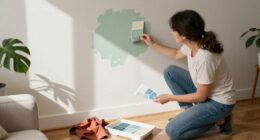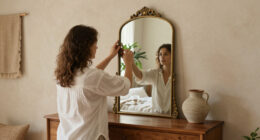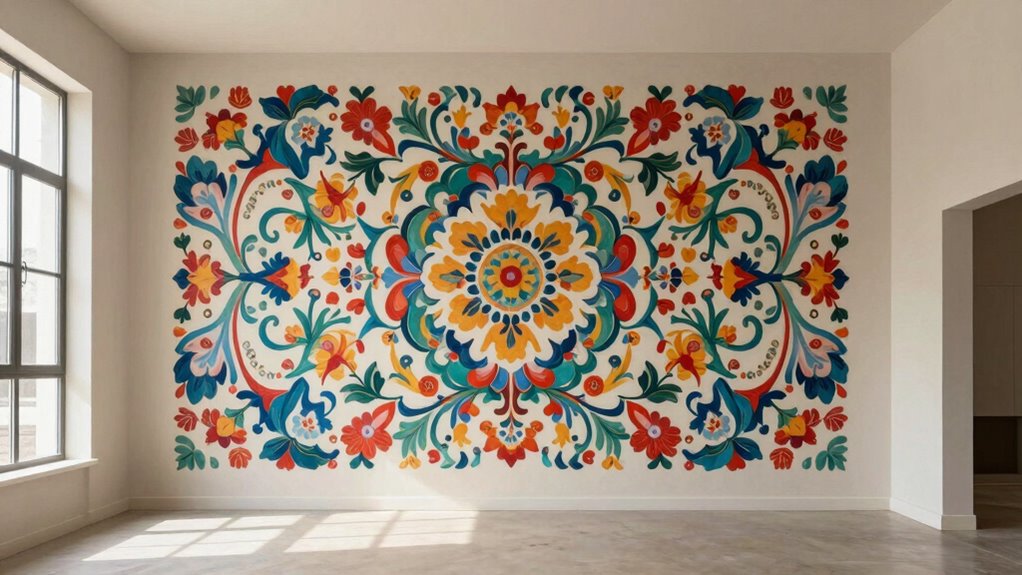
To center a wall mural in an open room, select the main wall that naturally draws attention. Measure the wall carefully to find its exact center, then position the mural so it’s aligned both horizontally and vertically. Make sure the mural’s size complements the space, and leave enough room around it for balance. Use lighting to highlight it, and arrange furniture to emphasize the focal point. Keep going to discover more tips for perfect placement.

Get furniture and decor delivered free with Prime
- Fast, free delivery on millions of items
- Prime Video, Amazon Music and more included
- Member-only deals all year
Key Takeaways
- Measure the wall’s dimensions and mark the center point both horizontally and vertically.
- Position the mural so its center aligns precisely with the wall’s central point.
- Ensure the mural is balanced within the space, considering surrounding furniture and room proportions.
- Use appropriate lighting to highlight the mural and create visual focus.
- Arrange furniture to frame the mural without obstructing it, enhancing its role as the room’s focal point.
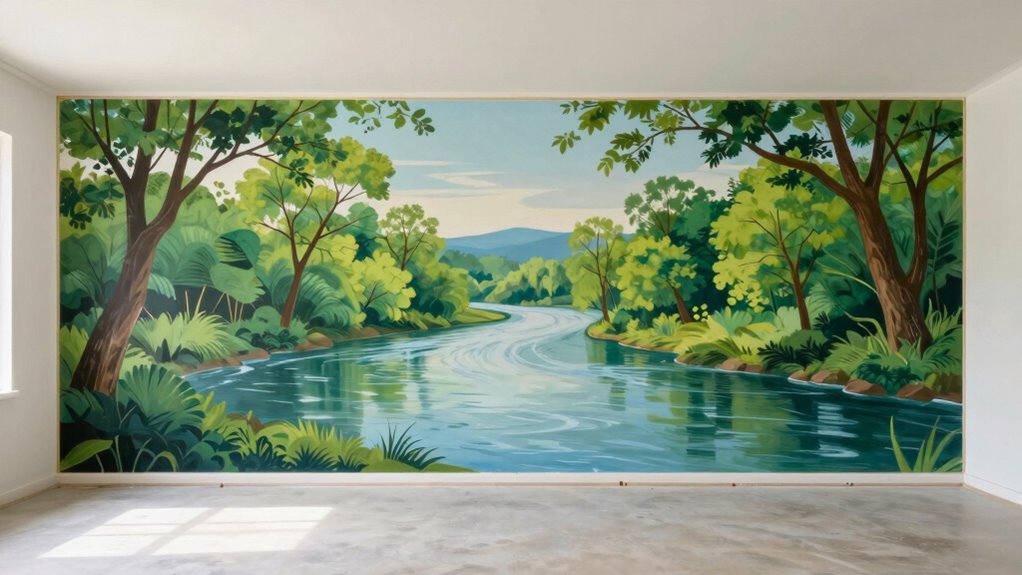
Centering a wall mural might seem tricky, but with the right approach, you can achieve a perfectly balanced look. When working in an open room, the key is to regard how the mural interacts with the entire space. Your goal is to create harmony between the artwork, furniture, and lighting to make the mural a central feature rather than an afterthought. Start by establishing a clear focal point; this usually means choosing the wall where the mural will be the star of the room. Once you’ve selected the wall, measure its dimensions carefully. Use these measurements to determine the mural’s ideal placement—generally, the goal is to have the mural centered horizontally and vertically within the space to avoid a top- or bottom-heavy appearance.
Next, think about your furniture arrangement. Position your furniture in a way that accentuates the mural without blocking or overpowering it. For example, if you’re placing a sofa or chairs in front of the mural, make sure they’re arranged to frame it rather than obscure it. Leave enough space around the mural so it can breathe and be appreciated from different angles. This spacing ensures your furniture complements the mural’s placement, creating a cohesive look that guides the eye naturally toward the artwork. Considering visual balance can also help ensure the mural remains the focal point without overwhelming the space. Additionally, paying attention to spatial proportions helps maintain a harmonious environment where the mural enhances rather than dominates.
Lighting techniques are equally important. Proper lighting can make or break your mural’s visual impact. Use a combination of ambient, task, and accent lighting to highlight the mural’s details and colors. Track lighting, wall-mounted fixtures, or even adjustable spotlights can be directed at the mural, emphasizing its focal presence. Avoid harsh glare or uneven lighting, which can distract from the mural’s design. Instead, aim for soft, even illumination that enhances the mural’s features without creating unwanted shadows. When planning your lighting, contemplate the room’s natural light as well; position fixtures to complement daylight and prevent reflections or glare. Additionally, understanding lighting techniques can help you maximize the mural’s visual appeal and create a welcoming atmosphere.
As an affiliate, we earn on qualifying purchases.
Frequently Asked Questions
How Do I Measure Wall Dimensions Accurately?
To measure wall dimensions accurately, start by using a tape measure to record the width and height of your wall. Note these measurements carefully, and double-check for consistency. When planning your mural, consider color coordination and the mural style to guarantee it complements the room. Mark the center point of the wall with a pencil, then measure outward to align the mural precisely, creating a balanced, visually appealing display.
What Tools Are Best for Marking Center Lines?
Imagine you’re planning a large mural, and accurate center lines are essential for perfect alignment. Using a laser level is your best tool for marking center lines, especially in open rooms. It guarantees precision, helping you achieve professional results. For artistic techniques in mural design, clear center lines guide your work, preventing distortions. Trust a laser level or chalk line; these tools make marking center lines straightforward and effective for your project.
How Do I Handle Uneven or Textured Walls?
To handle uneven or textured walls, start by gently sanding rough spots to create a smoother surface. Use a level and a pencil to mark your center lines carefully, accommodating the wall’s texture. Consider applying a primer or leveling compound if the texture is significant, which helps the mural adhere better. Take your time, and press the mural firmly onto the wall to make sure it sticks evenly across uneven surfaces.
Should I Consider Lighting When Centering a Mural?
Did you know that proper lighting can boost a mural’s visual impact by up to 30%? When centering your mural, yes, you should consider lighting. Ambient lighting creates a soft glow, highlighting the entire wall, while accent lighting draws attention to specific details. Position lights strategically to avoid glare and shadows, ensuring your mural remains the focal point and looks stunning from every angle.
How Can I Adjust for Future Wall Repairs?
To adjust for future wall repairs, you should choose a paint color that closely matches the mural design, making any patches less noticeable. Keep a record of the mural’s exact dimensions and installation details. When repairs are needed, carefully patch and repaint, blending with the original paint color. This way, your mural remains seamless, even after touch-ups, and continues to be a stunning focal point in the room.
adjustable wall mural mounting kit
As an affiliate, we earn on qualifying purchases.
As an affiliate, we earn on qualifying purchases.
Conclusion
Now that you know how to center your wall mural like a pro, you’re all set to transform your space with confidence. Remember, it’s not just about the perfect placement but also about making your room truly your own. Take your time, keep your eye on the prize, and don’t rush the process. With patience and a steady hand, you’ll have a stunning focal point that’s worth its weight in gold. Happy decorating!
As an affiliate, we earn on qualifying purchases.
art gallery wall lighting fixtures
As an affiliate, we earn on qualifying purchases.
As an affiliate, we earn on qualifying purchases.
Columbus Day / Indigenous Peoples' Day Picks
long weekend sales
As an affiliate, we earn on qualifying purchases.