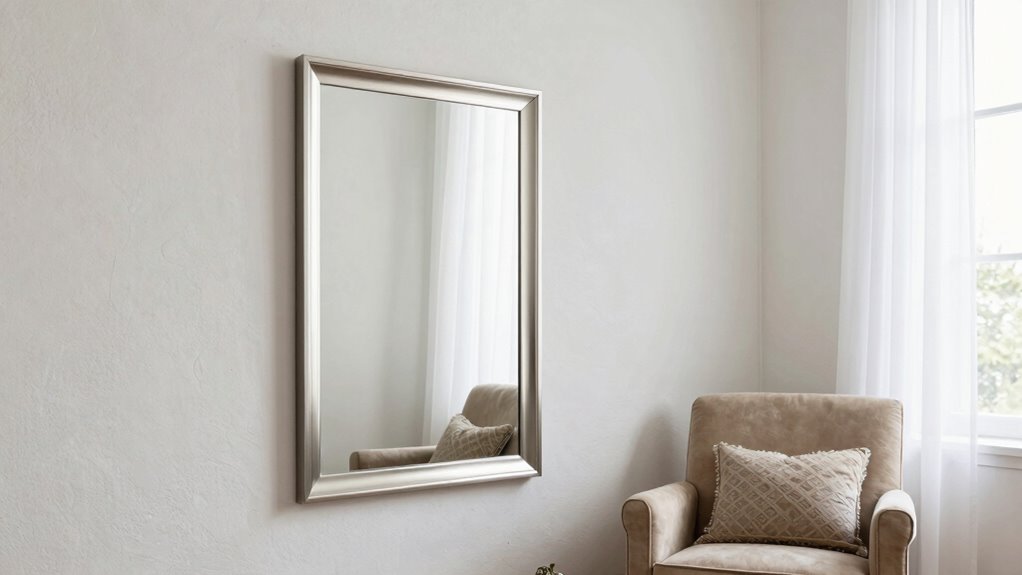

When your room’s features aren’t centered, focus on positioning your mirror based on the wall and decor instead. Measure and mark the wall’s midpoint, then align the mirror’s focal point with that line, not the room’s irregularities. Use lighting and surrounding accessories to create visual balance. Sometimes, slight offsets can make the space more interesting. If you want tips on perfect placement and adjustments, you’ll find helpful ideas below.

Get furniture and decor delivered free — and shop member deals
- Fast, free delivery on millions of items
- Access to Prime Big Deal Days deals on October 6–7
- Prime Video, Amazon Music and more included
Key Takeaways
- Focus on centering the mirror relative to the wall or focal point, not the room’s overall symmetry.
- Use measuring tools to find the wall’s midpoint, then align the mirror accordingly.
- Adjust the mirror’s height or angle to compensate for room irregularities and create visual balance.
- Slightly offset the mirror intentionally to achieve a more harmonious appearance within the space.
- Incorporate surrounding decor and lighting to enhance perceived symmetry and visual harmony.

Ever wondered how to perfectly center a mirror on your wall? It might seem tricky when the room itself isn’t perfectly aligned, but with a few simple steps, you can create a balanced, visually appealing look. The key is understanding how to work around an off-center room and focusing on the mirror’s placement rather than the room’s structure. The decorative frame of your mirror can significantly influence how you approach this; if it has a prominent or ornate frame, you want to make sure it’s the focal point, which means centering the mirror’s overall symmetry rather than just the wall or a particular spot. To do this, measure the width of the wall and decide where your eye should naturally fall, then mark those points lightly with a pencil.
Center your ornate mirror by measuring wall width and marking eye-catching focal points for a balanced, stylish display.
Next, you’ll want to focus on wall mounting techniques that help you achieve a centered look despite room irregularities. Use a tape measure and level to mark the exact midpoint of the wall, even if the furniture or other elements aren’t centered. Once you find that center, align your decorative frame so that its middle coincides with it. If your mirror has a heavy or decorative frame, ensure your wall mounting hardware is robust enough to support the weight securely. Proper wall mounting techniques involve using anchors if you’re installing on drywall or choosing studs for added stability. Mark the spots where your hardware will go, then double-check with a level to keep everything straight. Recognizing how room irregularities can impact visual balance is essential to achieving a harmonious look. Being aware of visual balance concepts can also help you make more effective placement decisions. Additionally, paying attention to lighting and surrounding decor can enhance the overall symmetry and aesthetic appeal. Incorporating visual tricks, like adjusting the height slightly above eye level, can further improve the balance and draw attention to the mirror. Sometimes, intentionally offsetting the mirror slightly can create a more dynamic and engaging display, especially when working with asymmetrical room features. When hanging the mirror, step back frequently to assess its position from different angles. Adjust as necessary until the decorative frame appears perfectly centered in relation to the wall and the surrounding space.
In the end, it’s about making intentional choices that emphasize balance rather than perfection. By carefully measuring, using proper wall mounting techniques, and considering the decorative frame, you can create a centered, harmonious look for your mirror—even if the room itself isn’t perfectly aligned.
As an affiliate, we earn on qualifying purchases.
Frequently Asked Questions
Can I Use Temporary Methods to Center a Mirror?
Yes, you can use temporary methods to center a mirror. Apply a temporary adhesive or removable mounting strips to hold it in place without damaging the wall. For more precise positioning, consider wall leveling tools to guarantee the mirror aligns perfectly. These methods are quick and easy, allowing you to adjust the mirror as needed before committing to a permanent solution.
What Tools Are Best for Precise Measurements?
You should use a measuring tape to get accurate distances from the mirror to the walls or nearby features. Pair it with a leveling tool to guarantee your mirror is perfectly straight. The measuring tape helps you mark precise points, while the leveling tool guarantees the mirror isn’t tilted. Together, these tools give you the accuracy needed to center your mirror, even if the room itself isn’t perfectly aligned.
How Do I Hide Irregular Wall Imperfections?
To hide irregular wall imperfections, start by inspecting your wall’s texture and identifying uneven spots. Use spackle or joint compound to fill in cracks or dents, then sand smooth for a seamless surface. If needed, apply paint touch-ups to blend repaired areas with the existing wall color. For added concealment, consider installing wallpaper, textured paint, or decorative panels, transforming imperfections into intentional design features.
Can I Move the Mirror Without Damaging the Wall?
You can move the mirror without damaging the wall if you’re careful and use the right tools. Start by gently loosening any hooks or brackets, and avoid yanking it free. Use a plastic pry tool or a flat screwdriver wrapped in tape to minimize wall damage. Take your time, and don’t rush—think of it as a walk in the park. Proper mirror placement guarantees your wall stays intact and your space looks great.
What Are Alternative Solutions if the Wall Is Uneven?
If the wall is uneven, you can consider wall leveling techniques like installing shims behind the mirror or using a leveler. For significant irregularities, plaster repairs can smooth out the surface, making it easier to hang your mirror evenly. You might also opt for a decorative frame that accommodates slight unevenness, creating an appealing look. These methods help guarantee your mirror appears centered despite the wall’s imperfections.
As an affiliate, we earn on qualifying purchases.
Conclusion
Now that you’ve learned how to center your mirror even when the room isn’t perfectly aligned, you’re like a skilled sailor adjusting your ship’s course amidst shifting currents. With a few simple measurements and a steady hand, you can navigate toward visual balance and harmony. Remember, sometimes it’s the little tweaks that make your space feel just right. So, set your sights, make those adjustments, and enjoy a room that feels perfectly anchored to your style.
As an affiliate, we earn on qualifying purchases.
As an affiliate, we earn on qualifying purchases.
Fall Picks
fall essentials
As an affiliate, we earn on qualifying purchases.