
TL;DR
Interior designers Miles Redd, Jan Showers and Marshall Watson say window treatments can shape how a room looks and feels, not just cover glass. Their advice focuses on hanging rods high, choosing a floor length that suits the room, selecting durable fabric and treating hardware as part of the design.
Interior designers Miles Redd, Jan Showers and Marshall Watson have outlined ways to give windows a more considered look, arguing that curtains and shades can influence a room’s proportions and finish as well as provide coverage. Their recommendations include mounting curtain rods high, choosing a length close to the floor, and matching fabric and lining to the room’s light and conditions.

Get furniture and decor delivered free with Prime
- Fast, free delivery on millions of items
- Prime Video, Amazon Music and more included
- Member-only deals all year
The designers describe window treatments as part of a room’s architecture rather than a finishing detail chosen only to cover a window. Watson said curtains can be used to make a ceiling seem taller or draw attention to an architectural feature. Showers similarly described drapery as a way to add texture and finish to a room, while Redd emphasized the combined effect of fabric, styling and hardware.
All three recommend placing rods high above the window when the room allows. Redd said hanging curtains directly above the window can leave a noticeable gap below the ceiling and make the room feel smaller. Watson suggested using a high pole or valance, with a Roman or translucent shade bridging the space between the ceiling and window when appropriate.
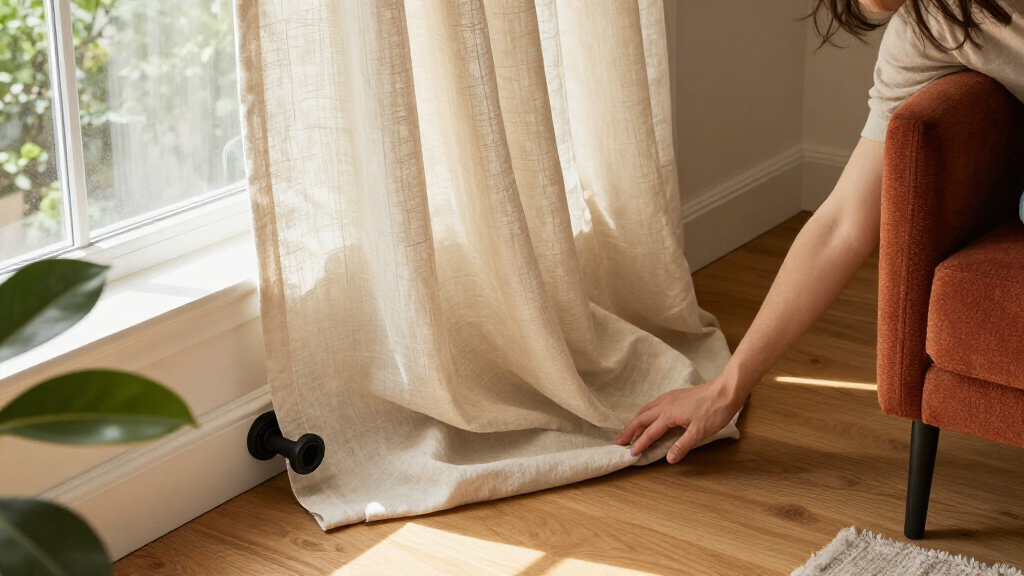
For length, Watson favors curtains that touch the floor or break by about an inch, while Showers prefers them barely clear of the floor. Both caution against curtains that are noticeably too short or drag heavily. Watson said apron-length curtains can suit some cottages, particularly where a window has molding beneath the sill. The source also advises considering a lining where strong sunlight needs to be filtered or blocked, or where a delicate fabric needs protection. Showers cautioned against fabrics that stretch and said silk in a sunny Texas setting needs lining because, she said, the sun can damage it over time.
Give windows a designer look
Curtains and shades shape a room’s proportions and finish as well as provide coverage. Three interior designers share practical guidance for height, length, fabric and hardware.
Start with the room
Treat window coverings as part of the architecture, with choices tailored to each opening.
Hang rods high
Mount rods as high as the room logically allows to draw the eye upward and avoid emphasizing the gap above the window.
Finish near the floor
Curtains can touch the floor or sit just above it. Avoid noticeably short or heavily pooling lengths.
Include the details
Rods and rings contribute to the finished look, so consider them alongside the fabric.
Choose fabric for the conditions
Light, exposure and material all affect how window treatments look and perform.
Decide whether the room needs sunlight filtered or blocked.
Consider durability and whether lining can protect delicate fabric from strong sun.
Use the ceiling, trim and window proportions to guide mounting and length.
What the designers emphasize
Their advice converges on treatments that work with the room’s architecture.
- High rods can make a ceiling seem taller.
- Fabric and drapery add texture and finish.
- Sun exposure can affect delicate fabric.
- The right arrangement depends on the window and room.
How Window Treatments Shape Rooms
The guidance matters because window treatments can change the apparent height and proportions of a room without altering its structure. A high rod can visually connect a window to the ceiling, while a poorly placed one may emphasize the gap above the frame. The fabric’s weight, fullness and finish also affect how much light enters and how the room feels.
There are practical stakes as well as aesthetic ones. A fabric exposed to direct sun may fade or weaken, and an unsuitable textile may stretch or hang poorly. Choosing a lining and a fabric suited to the conditions can affect privacy, light control and durability. The designers’ advice is guidance rather than a universal specification: the best arrangement depends on the window, the room and the material.
Hardware is another part of the result, not merely a support for the fabric. Redd said rods and rings can contribute to the look, and described a small bronze rod with understated rings as an option when a tailored effect is wanted. That makes the choice of hardware part of the same design decision as the curtain itself.
Products Worth Considering

Dyson Cyclone V10 Origin Cordless Vacuum

Samsung 65-Inch S90H OLED 4K Smart TV Bundle with HW-B630F Soundbar, Subwoofer, and Screen Cleaner (2026)

Bose SoundLink Plus Portable Bluetooth Speaker, Black
As an affiliate, we earn on qualifying purchases.
Design Advice From Three Specialists
The source brings together three designers with distinct approaches. Redd, of Redd Kaihoi, described learning curtain design from his former mentor, Bunny Williams, including how to combine an antique valance with contemporary fabric and use inventive pelmet shapes. Showers, a Dallas-based designer and author, spoke in favor of drapery as an architectural element that adds texture. Watson, of Marshall Watson & Reid Deane Ganes, discussed formal curtain styles and the importance of handling fabric carefully.
Their perspectives differ in emphasis, but overlap on several points: window treatments should be considered alongside the room’s architecture, hanging height affects how the space reads, and fabric and hardware work together. The source does not identify a single design rule that applies to every home; it presents the recommendations as professional guidance for weighing visual effect against light, climate and use.
“In decorating, curtains are generally not used to cover the window. Curtains are there to correct the architecture of a room, to elongate a ceiling height or emphasize an element of the room. They transform.”
— Marshall Watson, interior designer
Choices Depend on Each Window
The source offers no measurements or product recommendations that would settle decisions for every room. It does not specify exact rod heights, fabric weights, lining types or fullness ratios, and the appropriate choices will vary with ceiling height, window shape, sunlight and desired privacy. The advice to hang rods high is qualified by what is logical for the room rather than a fixed measurement.
The material also does not provide independent testing or cost comparisons for different fabrics and linings. Showers’s comments about silk in Texas reflect her stated experience and should not be read as a guarantee of how a fabric will perform in every climate or exposure. Readers may need to check fabric-care guidance and consult a drapery workroom for a particular window.
Measure, Select and Install
The next step for a homeowner is to assess each window’s light, privacy needs and surrounding architecture, then measure the available wall and ceiling space before selecting a rod and curtain length. Fabric samples can help show how color and texture look in the room’s actual light. Where sun exposure is strong, ask the supplier or workroom about lining and care requirements before ordering.
For custom or unusually shaped windows, a drapery workroom or interior designer can advise on construction, fullness and mounting. The source does not announce a product launch or a new industry standard; it offers design recommendations. The final result will depend on the room and the choices made for each opening.
Key Questions
How high should curtain rods be mounted?
The designers recommend mounting rods as high as the room logically allows, rather than directly above the window. The right position depends on the ceiling, trim and window proportions; the source gives no universal measurement.
Should curtains touch the floor?
Watson recommends curtains that touch the floor or have about a one-inch break. Showers prefers them to sit just above it. Both advise against curtains that are conspicuously short or heavily pooled, while Watson notes that apron-length can suit some cottage settings.
When should curtains be lined?
A lining may help filter or block sunlight and protect delicate fabric. The source specifically notes that Showers lines silk used in sunny Texas conditions, but the best choice depends on the fabric, exposure and desired light control.
Does curtain hardware affect the design?
Yes. Redd says poles and rings contribute to the finished look and should be considered alongside fabric and styling. The source gives a small bronze rod and simple rings as one understated option, not a rule for every room.
Source: veranda.com