TL;DR

Get furniture and decor delivered free — and shop member deals
- Fast, free delivery on millions of items
- Access to Prime Big Deal Days deals on October 6–7
- Prime Video, Amazon Music and more included
A Hunker report features YouTuber Mireyak’s do-it-yourself project, which repurposes empty tuna cans as painted hanging holders for small potted plants. The method uses three holes and strings to suspend each can; the plant should remain in its own pot so water can drain.
YouTuber Mireyak’s tuna-can planter project turns empty food cans into small hanging holders for potted plants, according to a how-to report by Hunker. The low-cost craft uses paint, string and a few basic tools, offering plant owners a way to reuse packaging rather than buy a new decorative planter.
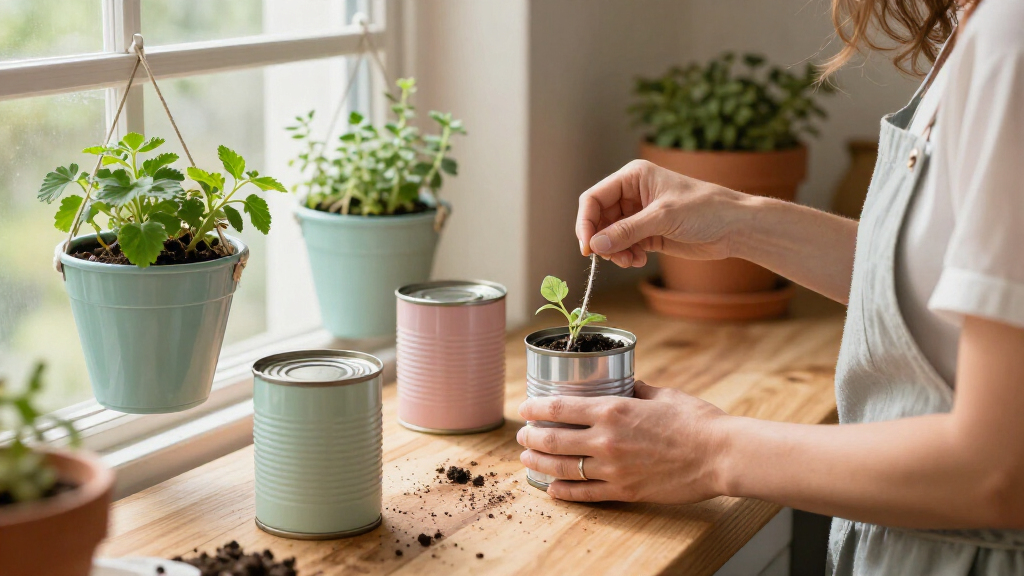
In the project described by Hunker, Mireyak paints a tuna can, decorates it, then suspends it with three lengths of string. The strings pass through holes spaced around the can’s rim and are knotted in place; their free ends are tied together to make a hanger. Hunker says a drill can make the holes, while a hammer and nail are offered as an alternative.
The featured design uses a white base coat, a green layer, white splatters and light-green botanical details. The report also suggests other paint patterns, but those are alternatives rather than designs shown as part of Mireyak’s project. It recommends applying a clear sealer after painting and allowing the finish to dry before assembling the hanger.
Because tuna cans are small, Hunker says they are best suited to small houseplants, including succulents and mini cacti, or to holding small cuttings for propagation. The plant should stay in its own pot inside the can rather than being planted directly in it, so it can drain after watering. Hunker lists the can, craft paint, brushes, string, clear sealer and a tool for making holes as the materials needed.
A Small-Scale Way to Reuse Packaging
The project offers a practical example of reusing an ordinary food container for home decor. For people who already have an empty can and basic craft supplies, the holder may cost little to make, although the source does not provide a price comparison or estimate of savings. Its appeal is also flexible: the can can be painted to suit a room, and several can be hung at different heights to display small plants.
The idea has limits. A tuna can is not a conventional planter with built-in drainage, and the instructions avoid that problem by keeping the plant in its original pot. That distinction matters for plant care: the can functions as a decorative outer holder, not as a container to fill with soil. Readers should also take care when making holes in metal, which can leave sharp edges; the report does not detail specific protective equipment or edge-finishing steps.
As an affiliate, we earn on qualifying purchases.
How Mireyak Builds the Hanger
Hunker’s report presents the project as one of several possible uses for empty tuna cans, focusing on a hanging planter made by Mireyak. The article credits Mireyak as a YouTuber, but the supplied report does not include a publication date, video link, or further details about her. The available account is therefore a description of the craft, not an independently documented test of how well the planter holds up over time.
The method described has two stages: decorate and seal the can, then attach the strings. Once the paint and clear coat are dry, make three evenly spaced holes near the rim. Thread and knot one string through each hole, then bring the other ends together and tie them into a hanger. Hunker says a hook in a well-lit area can display the finished holder; grouping several at different heights is another suggested arrangement.
“The cans are small.”
— Hunker, describing the project
As an affiliate, we earn on qualifying purchases.
Durability and Safety Details Are Missing
The source does not say how long the paint or sealer lasts, how much weight the strings or can can safely support, or whether the metal needs extra treatment to resist rust. It also does not report whether Mireyak tested the hanger with different plant pots or after repeated watering. Those factors may affect how and where someone chooses to display a finished piece.
Hunker mentions making holes with a drill or hammer and nail but gives no detailed safety guidance, including how to secure the can or handle sharp edges. The article also does not identify specific paint or sealer products beyond naming Mod Podge as an example of a clear sealer. Readers should check the instructions for their chosen materials and avoid assuming that every coating is suitable for contact with water.
As an affiliate, we earn on qualifying purchases.
A DIY Idea, Not a Product Launch
The supplied report describes a craft project rather than a commercial product or scheduled event. It does not announce a release date, wider rollout or follow-up from Mireyak. Anyone following the instructions can adapt the decoration and use the finished can as a holder for a small potted plant, while keeping in mind that the original report leaves questions about long-term durability and safe load limits unanswered.
hanging planter kit for small plants
As an affiliate, we earn on qualifying purchases.
As an affiliate, we earn on qualifying purchases.
Key Questions
What materials does the tuna-can planter project use?
Hunker lists an empty tuna can, craft paint, paintbrushes, string and a clear sealer. A drill is one option for making holes; a hammer and nail are suggested as an alternative.
What plants are suitable for the holder?
The report recommends small plants such as succulents and mini cacti, as well as small cuttings. It does not give a weight limit or name specific plant varieties beyond those examples.
Should the plant be planted directly in the can?
No. Hunker advises placing a plant in its own pot inside the can so it can drain after watering. The can is described as a hanging holder, not a soil-filled planter.
How is the can suspended?
Make three evenly spaced holes around the rim, thread a separate piece of string through each hole and knot them. Tie the loose ends together to form the hanger, then suspend it from a suitable hook.
Does the report establish how durable or safe the planter is?
No. The source gives assembly instructions but does not report durability testing, a safe weight limit or detailed guidance for handling sharp metal edges. Those points remain unclear.
Source: rss
Halloween Picks
halloween
As an affiliate, we earn on qualifying purchases.