TL;DR

Get furniture and decor delivered free with Prime
- Fast, free delivery on millions of items
- Prime Video, Amazon Music and more included
- Member-only deals all year
A Hunker report outlines a DIY macrame privacy screen as a decorative alternative to a traditional fence or hedge for a yard or patio. The project uses weather-treated or synthetic cord and a securely mounted support, but the screen’s privacy and durability depend on its design, materials and installation.
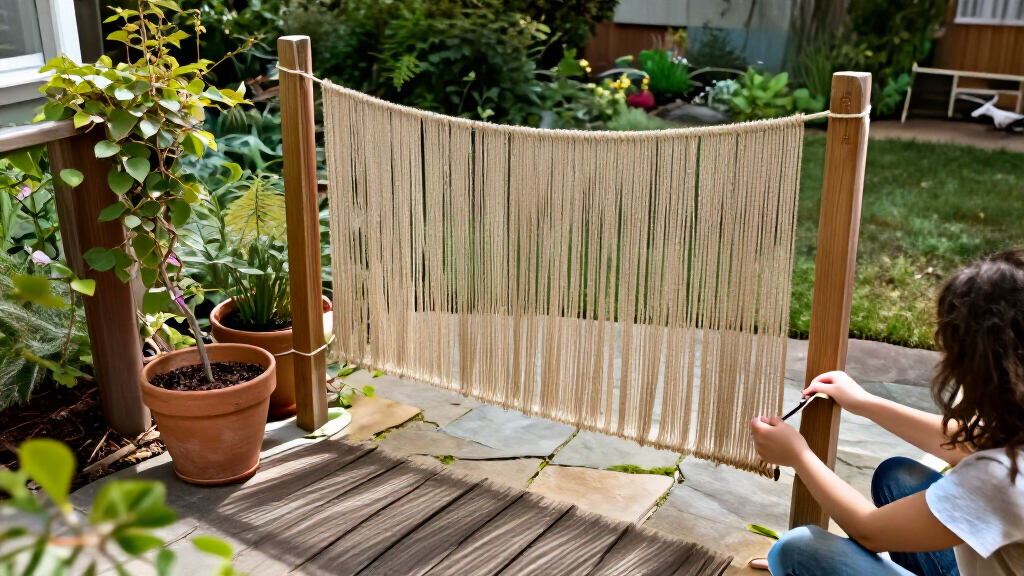
Hunker has outlined a DIY macrame privacy screen for homeowners seeking a decorative alternative to a traditional yard fence or hedge. The project uses woven cord hung from a sturdy rod, frame or pergola to create a partial screen for a backyard or patio; it is not described as a replacement for a full fence or guaranteed visual barrier.
The report estimates that a 2-by-5-foot panel may require about 200 yards of synthetic or weather-treated fabric, along with a wooden or metal support. It lists curtain rods, pergolas and other suitable supports as possibilities, with heavy-duty hooks, eye screws, brackets or zip ties among the potential fastening materials. The materials needed will vary by design, so the report advises planning for extra cord.
To make a panel, the instructions say to attach the support above the area to be screened, then cut cords to twice the desired finished length. Each cord is folded in half and secured to the support with a lark’s head knot. The maker then weaves rows in a chosen pattern. The article points to online patterns and examples, including work by Rachel of A Beautiful Mess and tutorials by Deepa Rai on YouTube.
Possible variations include adding beads, integrating plant hangers, placing planters at the base or using a folding room-divider frame. Hunker presents these as customization options rather than requirements. It also suggests weatherproofing a frame intended for outdoor use; the source does not give a specific treatment or maintenance schedule.
A Flexible Screen for Patios
A macrame panel offers a way to create some separation without a conventional fence, while letting the homeowner choose its pattern, size and placement. A free-hanging curtain can suit a covered patio, while a movable divider may work for spaces where privacy is needed only at certain times. Those options may appeal to renters or homeowners who want a changeable feature, though the report does not address lease rules, local restrictions or the screen’s performance in different settings.
The distinction between a decorative screen and a boundary matters. The source describes the project as adding a bit of solitude, not as securing a yard or blocking all views. Open knot patterns can leave sightlines through the material, and wind, rain and sun may affect an outdoor installation. Readers should choose materials and placement with those limits in mind and confirm that supports can hold the finished screen safely.
weather-resistant macrame cord for outdoor privacy screen
As an affiliate, we earn on qualifying purchases.
As an affiliate, we earn on qualifying purchases.
From Cord to Outdoor Divider
Macrame is a form of knotting with a history the Hunker report traces to the 13th century, when it had both decorative and functional uses. The article draws on that craft tradition for a contemporary outdoor project, pairing woven cord with a fixed or portable frame. Its central idea is to combine a handmade decorative element with a practical, limited privacy screen.
The report characterizes the project as beginner-friendly and budget-friendly, but supplies no cost estimate or tested installation results. Material needs can change with panel dimensions, knot pattern, cord thickness and the support structure. Its 200-yard estimate applies to the stated 2-by-5-foot panel, not necessarily to larger screens or every pattern.
“For a 2-by-5-foot panel, the report says to allow “about 200 yards” of synthetic or weather-treated fabric.”
— Hunker report
outdoor curtain rod heavy-duty hooks
As an affiliate, we earn on qualifying purchases.
As an affiliate, we earn on qualifying purchases.
Privacy and Weather Limits
The source does not provide independent testing of how much privacy a macrame screen offers, how long it lasts outdoors or how it performs in wind and rain. It also does not identify a single cord type, knot pattern or support system as suitable for every yard. The stated material estimate is approximate, and costs, installation time and maintenance needs are not specified.
Whether a divider meets a particular household’s privacy needs depends on its height, weave density, placement and surroundings. The article does not discuss local rules, property boundaries or permission requirements for attaching a support to a home or shared structure. Those details should be checked before installation.
As an affiliate, we earn on qualifying purchases.
Plan the Support Before Weaving
Anyone trying the project can start by measuring the area and deciding whether the screen will hang from a fixed support or sit on a movable frame. The Hunker instructions recommend securing the support with hardware suited to its location and allowing for the finished screen’s weight. Buyers should select synthetic or weather-treated cord intended for outdoor conditions and keep receipts in case excess material can be returned.
After choosing a pattern, the maker can test the weave on a small section before completing the panel and check whether the finished openings provide enough screening. For a freestanding option, the frame may need weatherproofing. The source offers no further update or scheduled next step; durability and the degree of privacy will depend on the finished design and its outdoor conditions.
weatherproof outdoor support frame for macrame
As an affiliate, we earn on qualifying purchases.
As an affiliate, we earn on qualifying purchases.
Key Questions
How much cord does the project require?
Hunker estimates about 200 yards of synthetic or weather-treated fabric for a 2-by-5-foot panel. The amount can vary with the pattern and materials.
Can a macrame screen replace a fence?
The article presents it as a decorative way to add some privacy, not as a secure boundary or a guaranteed full visual barrier. Open patterns may leave views through the screen.
What can support the screen?
The report lists a curtain rod, pergola, wooden or metal frame as possible supports. The chosen structure and fasteners need to hold the completed panel securely.
Can the divider be moved?
Yes. Hunker suggests using a folding room-divider frame for a screen that can be repositioned. A frame used outdoors may need weatherproofing.
Is the screen suitable for every outdoor space?
The source does not establish that. Weather exposure, support strength, local rules and the desired level of privacy all affect whether a particular design is appropriate.
Source: rss
Halloween Picks
halloween
As an affiliate, we earn on qualifying purchases.