TL;DR

Get furniture and decor delivered free with Prime
- Fast, free delivery on millions of items
- Prime Video, Amazon Music and more included
- Member-only deals all year
A Hunker DIY report describes turning one secondhand wood board into doors that cover open bathroom shelving. The project uses measurements, soft-close European hinges and a cut-after-installation method to keep the wood grain aligned; fit and structural details depend on the individual shelving niche.
Hunker has described a way to cover open bathroom shelves by converting one piece of secondhand lumber into matching cabinet doors. The report draws on a TikTok project by John Dolechek, whose method installs the board as one panel before cutting it into separate doors, helping preserve a continuous wood-grain appearance across the closed shelves.
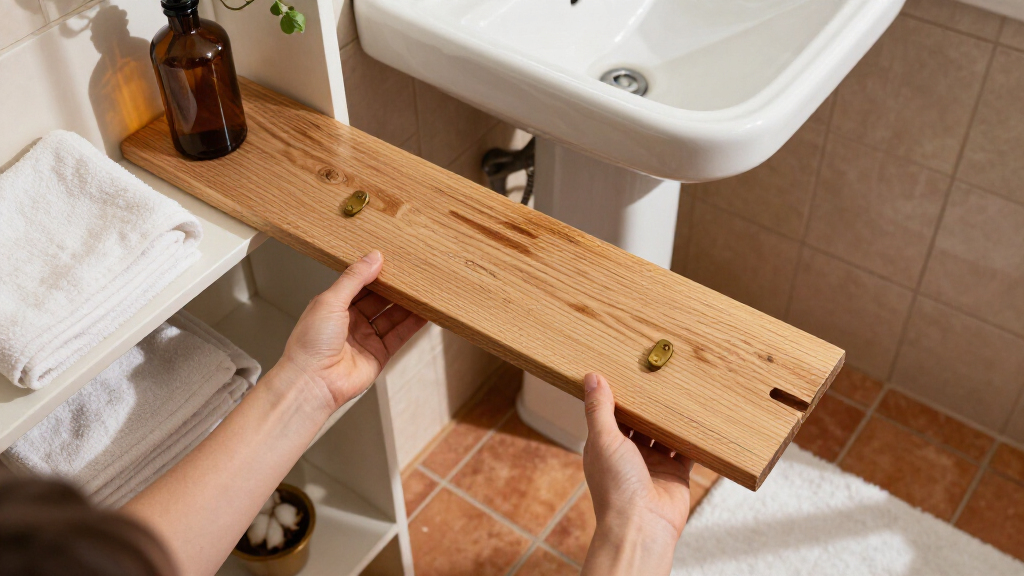
The approach is intended for bathroom niches and other open shelving where everyday supplies remain visible. Rather than buying or building a full cabinet, the project uses a board sized to cover the opening, soft-close European hinges, and finishing materials such as stain or paint. The source estimates that Dolechek’s board looked roughly like a 1-by-16-inch board about six feet long; that is an estimate from the report, not a standard size for every installation.
Hunker recommends measuring the full opening before sourcing lumber and checking the board’s actual dimensions. Nominal lumber sizes can differ from their finished measurements: the report gives a nominal 1-by-16 as an example, with an actual size of about three-quarters of an inch thick by 15.25 inches wide. A board that is too narrow will not fully cover the shelves, so the required dimensions depend on the particular niche.
For stained doors, the guide advises planning and fitting the hinges while the board is still whole. After mounting the panel, the maker marks the horizontal cut lines, removes the board, cuts it into individual doors, then sands and applies matching edge banding. This order is meant to help the grain line up when the doors are closed and lets the separate pieces receive a coordinated finish. The report also says painted doors can be marked and cut without first completing the full installation.
A Low-Cost Way to Conceal Bathroom Storage
The project offers a practical option for people who want to hide toiletries and household supplies without replacing an existing shelving niche with a full cabinet. A reused board may be available through architectural salvage stores, Habitat for Humanity retail stores, Facebook Marketplace or leftover materials from another project, according to Hunker. The source does not provide a total project cost, so savings will depend on the board, hinges, tools and finish a homeowner already has or needs to buy.
There is also a visual benefit to the single-board method: when separate panels are cut from one length of wood, the grain can continue across the closed doors. That detail may make a simple retrofit look more unified than doors made from unrelated pieces. But appearance and function both rely on accurate measuring, suitable hinge placement and a frame or stud that can support the hardware.
The doors conceal stored items; they do not add storage capacity or address problems such as dampness, leaks or poor ventilation. The project is best understood as a custom cover for existing shelves, not a complete bathroom renovation or a guaranteed fit for every wall niche.
European soft-close hinges for cabinets
As an affiliate, we earn on qualifying purchases.
As an affiliate, we earn on qualifying purchases.
How the Single-Board Method Works
The source frames the project as a response to the gap between styled photographs of open shelving and the everyday items commonly kept in bathroom storage. Dolechek shared his project on TikTok, where he said he was answering questions about how the bathroom would have privacy. Hunker’s report focuses on the construction method rather than providing a measured cost, a complete set of dimensions or an independently tested product review.
The guide allows for different layouts: a maker can create a door for each shelf section, combine several sections behind fewer doors, or use one tall door. For each panel, Hunker suggests a pair of hinges, with a third hinge for a taller door that needs added support. Cup holes for concealed European hinges can be made with a 35-millimeter Forstner bit or a concealed-hinge jig. The source cites a jig priced at $32.98 on Amazon, but that is a listed price in the report and may change.
After installation and cutting, edge banding covers exposed board edges. Hunker suggests staining to show the grain, painting to match trim, matching the wall color to make the doors blend in, or choosing an accent color. Hardware is optional. These are finish choices in the guide, not claims that a particular color or treatment will suit every bathroom.
““it’s easier to figure out the installation first before finishing the board so the doors only have to be stained once with the edge banding on.””
— Hunker’s report
reclaimed wood bathroom cabinet doors
As an affiliate, we earn on qualifying purchases.
As an affiliate, we earn on qualifying purchases.
Fit Depends on Each Shelving Niche
The supplied report does not give verified measurements for Dolechek’s shelves, a complete materials budget, or information about how the installation performs over time. Its description of the board’s size is approximate. Readers will need to measure their own opening and check whether it has an inner frame or accessible framing that can safely carry the hinges.
It is also unclear whether the method suits every niche. Fixed dividers, uneven walls, plumbing, limited clearance or a lack of suitable framing could affect the door layout and installation. The source offers general options but does not provide a project-specific assessment or local building requirements. No independent test or follow-up confirming the finished doors’ durability is included.
cut-to-fit wood panels for shelving concealment
As an affiliate, we earn on qualifying purchases.
As an affiliate, we earn on qualifying purchases.
Measure Before Buying the Board
For anyone considering the project, the next step is to measure the opening and decide how many door panels will work with the shelf dividers. Check the lumber’s actual width and thickness rather than relying on its nominal label, then confirm hinge locations and support before cutting or drilling. The single-board installation sequence is particularly relevant to stained finishes, where preserving grain alignment is part of the intended look.
Once the layout is confirmed, the project can proceed with sourcing the board, hinges and finish, followed by a test fit, cutting, edge banding and final finishing. Hunker does not announce a product launch or a scheduled follow-up; the report is a practical DIY guide, and the result will depend on the dimensions and construction of each bathroom’s shelving.
sanding and finishing wood for DIY doors
As an affiliate, we earn on qualifying purchases.
As an affiliate, we earn on qualifying purchases.
Key Questions
What is the main idea behind the project?
Use one piece of secondhand wood to make matching doors that cover open bathroom shelves, cutting the board into panels after installing it as a single piece.
Why install the board before cutting it into doors?
Hunker says the approach helps keep the wood grain aligned across the separate panels when they are closed. It also lets the maker plan hinge placement against the actual opening.
What supplies does the guide recommend?
The listed materials include a board large enough to cover the shelves, soft-close European hinges, stain or paint, optional hardware and matching edge banding. A hinge jig or a 35-millimeter Forstner bit may be used to make hinge cup holes.
Will one board fit every bathroom shelf niche?
No. The needed board size and door layout depend on the niche’s measurements, dividers and framing. Hunker advises measuring the opening and checking actual lumber dimensions before cutting or buying materials.
Source: rss
Fall Picks
fall essentials
As an affiliate, we earn on qualifying purchases.