TL;DR

Get furniture and decor delivered free — and shop member deals
- Fast, free delivery on millions of items
- Access to Prime Big Deal Days deals on October 6–7
- Prime Video, Amazon Music and more included
Livingetc reports that Capiz shell lighting is appearing again in interior design projects, more than 60 years after Verner Panton’s Fun series brought a similar look to wider attention. Designers interviewed by the publication say the shells diffuse light and add a pearlescent accent, though the report offers no sales figures or evidence of how widespread the revival is.
Capiz shell lighting is reappearing in interior design projects, according to a recent report by Livingetc, as designers use the translucent, pearlescent material to soften light and add a reflective accent to rooms. The renewed interest draws on a tradition that includes Danish designer Verner Panton’s 1964 Fun series, but the report does not establish how widespread the trend is across the market.
Livingetc describes Capiz fixtures as a return of a look associated with Panton’s hanging Fun lights, made with shiny discs that move and catch the light. The publication says similar designs are now appearing in homes, hotels and designers’ projects, and predicts that the material will feature more often in the coming year. It does not cite sales data, a survey or a count of new installations to measure that increase.
Australian designer Greg Natale told Livingetc that Capiz has organic, translucent and pearlescent qualities that introduce a subtle iridescence. Describing a dressing room at a London House project, he said the light reflected onto floral wallpaper and added movement to a marble countertop and patterned carpet. His example shows how designers may use the material alongside detailed surfaces, rather than reserving it for coastal-themed rooms.
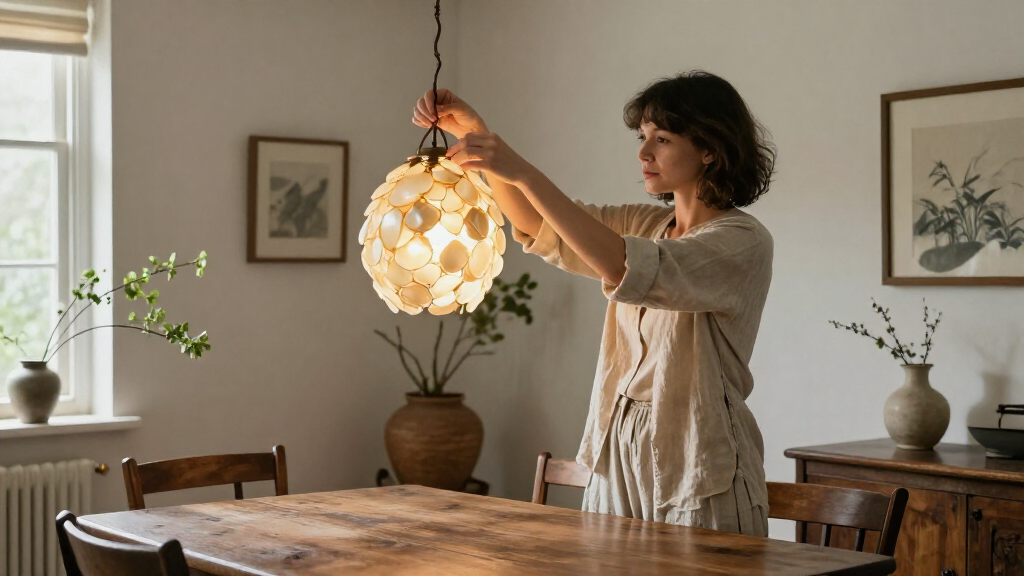
Designers interviewed by the publication also point to the way the shells change the light. Alex Bucklin, founder of Bucklin Design Co., said their translucent surfaces soften and diffuse light compared with clear glass. Bucklin described an illuminated fixture as appearing to glow from within, creating a warm effect while still drawing attention as a focal point. These are designers’ assessments of the material’s visual effect, not measured claims about light output or energy use.
A Softer Alternative to Clear Glass
The reported return matters to readers choosing decorative lighting because a Capiz fixture can serve two purposes: it provides illumination and acts as a feature with a distinct surface and silhouette. Its appeal, as described by designers, comes from diffused light and a pearly sheen, rather than the crisp transparency of glass or the solid look of many metal fittings.
That quality may make the material relevant beyond coastal interiors. Livingetc says designers are using it in settings where its reflective finish contrasts with modern furnishings and richly patterned rooms. It can therefore offer a different visual note from the earth tones and wood finishes that the article says have been prominent in recent interiors. Whether that shift amounts to a broad change in consumer taste is not established by the report.
For homeowners, the practical takeaway is to treat Capiz as a design choice whose effect depends on placement, scale and surrounding finishes. A fixture may add visual texture in a dressing room or bring a softer glow to a bathroom, but the article does not provide product comparisons, price ranges or technical guidance. Readers would need to check an individual fitting’s dimensions, bulb compatibility and care requirements before buying.
As an affiliate, we earn on qualifying purchases.
From Windowpanes to Pendant Lights
Capiz is the common name for the windowpane oyster, or Placuna placenta, found around Southeast Asian coasts and especially associated in the article with the Philippines. Livingetc says the shells have been harvested and used there for thousands of years. Their translucent quality made them a lower-cost alternative to glass, and shell-covered windowpanes can still be found in some homes and churches.
The material’s current use in lighting builds on that ability to transmit and interact with light. Livingetc traces the modern decorative association to Verner Panton’s 1964 Fun series, whose cascading reflective discs became a recognizable design reference. The article does not claim that Panton originated all uses of Capiz or establish a direct line between traditional windowpanes and today’s fixtures; it presents the series as a style that helped popularize a related look.
Designers quoted by Livingetc connect renewed interest to a preference for materials that appear natural and less uniform than sleek, minimalist finishes. That explanation is professional interpretation, not a documented survey of buyers. The report frames Capiz as one example of a broader interest in tactile and nature-linked materials, while emphasizing its particular interaction with light.
““The shells are translucent rather than transparent, so they soften and diffuse the light instead of giving you the harder, more direct glow you can get through clear glass.””
— Alex Bucklin, founder of Bucklin Design Co., quoted by Livingetc
translucent Capiz shell chandelier
As an affiliate, we earn on qualifying purchases.
As an affiliate, we earn on qualifying purchases.
How Broad Is the Revival?
Livingetc’s report identifies examples from designers and says similar fittings are available from multiple lighting retailers, but it provides no market figures, consumer research or date range for the trend’s return. It is not clear how many projects are using Capiz, whether demand has measurably increased, or how the material compares with alternatives in price and durability.
The article also forecasts more Capiz lighting in the coming year without naming specific forthcoming projects or products. That forecast should be read as a design expectation, not a confirmed industry-wide development. The source material does not detail the sourcing practices or environmental effects of harvesting shells, nor does it provide specifications for individual fixtures.
Pearlescent shell lighting fixture
As an affiliate, we earn on qualifying purchases.
As an affiliate, we earn on qualifying purchases.
Watch for New Design Projects
Livingetc expects Capiz lighting to appear in more interiors over the coming year, but it does not identify a particular launch or event that would confirm the forecast. Readers can look for new project coverage and product listings from lighting retailers to see whether designers continue to use the material outside coastal-style rooms.
For anyone considering a fixture, the next step is to assess the specific product rather than rely on the trend label: check its construction, light source, dimensions and suitability for the intended room. The report establishes a renewed design conversation around Capiz, but broader popularity and longer-term demand remain to be seen.
As an affiliate, we earn on qualifying purchases.
Key Questions
What is Capiz shell lighting?
It is lighting made with pieces of Capiz shell, from the windowpane oyster. The translucent shell surfaces catch and diffuse light, giving fixtures a pearlescent appearance.
Why are designers using Capiz again?
Designers quoted by Livingetc say the material adds a natural-looking, softly reflective finish and diffuses light. The report suggests renewed interest, but does not provide consumer or sales data to quantify it.
Is Capiz lighting only suited to coastal interiors?
No. Livingetc says designers are also placing it in settings beyond coastal homes, where its sheen can contrast with modern furnishings or patterned surfaces. The right fit depends on the room and fixture design.
Does Capiz lighting produce less direct light than clear glass?
Designer Alex Bucklin told Livingetc that Capiz shells soften and diffuse light compared with clear glass. The article does not include technical measurements, so the effect will vary by fixture and bulb.
Is the Capiz trend proven to be growing across the market?
No market-wide growth is established in the report. Livingetc cites design projects and retailer availability, and predicts further interest, but supplies no sales figures or survey results.
Source: rss
Halloween Picks
halloween
As an affiliate, we earn on qualifying purchases.