
TL;DR

Get furniture and decor delivered free with Prime
- Fast, free delivery on millions of items
- Prime Video, Amazon Music and more included
- Member-only deals all year
A Livingetc report explains kogei as everyday objects shaped by regional materials, inherited techniques and human judgment—not simply handmade goods. The approach highlights the networks behind Japanese craft, whose traditional-industry workforce fell from 288,000 people in 1979 to 48,334 in 2022, according to the report.
Drawing on an interview with Tasuku Ogino, executive vice president of Japanese retailer Nakagawa, the report describes kogei as tools for daily life shaped by practical knowledge built over generations. That knowledge reflects local ways of living, available materials and the skills of people working in a particular region.
The article distinguishes kogei from both art made primarily to be admired and industrial production focused on uniformity and efficiency. It argues that an object need not be handmade, rare, expensive or signed to fit the idea. Instead, its use, regional roots and continuing connection to inherited methods matter.
One example is Nakagawa’s Hana Fukin kitchen cloth. The cloth developed from kaya, a breathable mosquito-net fabric associated with Nara. Although it is woven on machines, workers adjust production to account for humidity and differences between looms. The report presents those adjustments as an example of human judgment remaining part of a mechanized process.
The People Behind Useful Objects
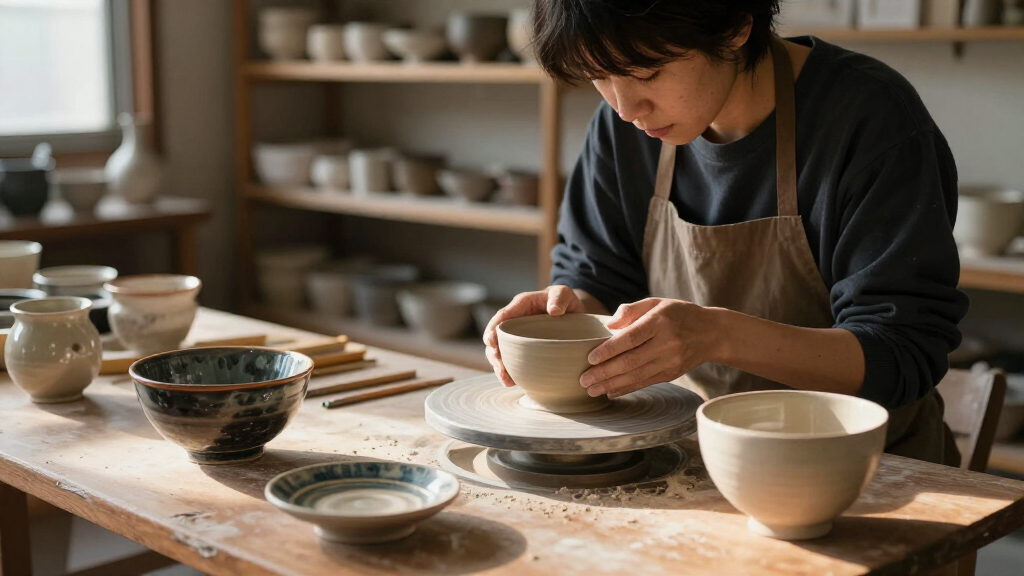
The account shifts attention from a finished object to the regional network of specialists that makes it possible. A ceramic piece, for example, may involve separate experts in clay, glaze, molds and firing. The report says those roles can depend on one another, so the loss of a specialist may affect others across the production chain.
That has implications for how readers interpret and display craft at home. Kogei is not just a look or a label for handmade decor; it describes a relationship between an object’s everyday function, its place of origin and the knowledge involved in making it. The article suggests that noticing those qualities can change how people see ordinary household items.
The workforce figures underline the concern, though they do not explain its causes. The decline from 288,000 workers in 1979 to 48,334 in 2022 points to a smaller workforce in the traditional craft industries. Ogino says Nakagawa hopes to pass on the regional ecosystems that support kogei, rather than only individual products or techniques.
Products Worth Considering

Google Nest Learning Thermostat (4th Gen) with Nest Temperature Sensor (2nd Gen), Silver

Bose Lifestyle Ultra Soundbar and Ultra Subwoofer Bundle

Samsung 48 4K OLED Smart TV (2026) with WireLogic 8ft Ultra High Speed HDMI Cable
As an affiliate, we earn on qualifying purchases.
How Kogei Differs From Craft
The term kogei (工芸) refers, in the report’s account, to useful objects rooted in local conditions and knowledge developed across generations. The distinction is not simply whether an object was made by hand. Machinery may be involved, while workers’ decisions and adjustments remain central to the process.
The report draws on Nakagawa’s history as well as Ogino’s explanation. Founded in Nara in 1716, the company says it now works with more than 800 workshops across Japan. The article also notes that Japan recognizes 244 traditional crafts, with at least one represented in each of the country’s 47 prefectures. These figures describe the breadth of the craft landscape; they do not mean every qualifying object is on the government’s traditional-craft list.
Collective production is another distinction. While Japan has recognized master artisans, the report says much everyday craft depends on multiple specialists and shared local expertise. Its examples frame kogei as an evolving practice: objects adapt to changing lifestyles while retaining knowledge embedded in their materials and production.
What the Report Does Not Establish
The report gives workforce totals for 1979 and 2022, but does not provide a year-by-year series, explain the reasons for the decline or specify how the figures were compiled. They should be read as two reported counts, not as evidence of any one cause or a precise annual trend.
It also does not identify which regions, trades or specialist roles have been most affected, or quantify how many workshops have closed. The article offers examples and Nakagawa’s perspective, but does not assess the financial outlook for the sector or show whether current efforts are reversing the decline.
Keeping Craft Networks Active
The report does not announce a new program, policy or scheduled milestone. It presents Nakagawa’s stated aim of sustaining the regional ecosystems behind kogei and describes how the company works with more than 800 workshops.
Further evidence about the sector would require updated workforce data, details on the condition of individual trades and information about efforts to train new specialists. For readers, the article’s immediate invitation is more modest: look beyond whether an object appears handmade, and ask how it is used, where its materials and methods come from, and whose expertise keeps its production going.
Key Questions
What does kogei mean?
In Livingetc’s account, kogei describes everyday tools and objects shaped by regional materials, inherited practical knowledge and makers’ skills.
Does an object have to be handmade to count as kogei?
No. The report says an object may be machine-made and still fit the idea if it is rooted in local conditions, draws on accumulated knowledge and depends on human judgment.
How is kogei different from decorative art?
The report emphasizes everyday use. Kogei is not defined by an object being made mainly for display, nor simply by industrial uniformity; its practical function and production knowledge are central.
Why is the craft workforce a concern?
The report cites a fall in employment in Japan’s traditional craft industries from 288,000 in 1979 to 48,334 in 2022. It says production may rely on networks of specialists, but does not detail the causes of the decline.
Source: rss