
TL;DR

Get furniture and decor delivered free with Prime
- Fast, free delivery on millions of items
- Prime Video, Amazon Music and more included
- Member-only deals all year
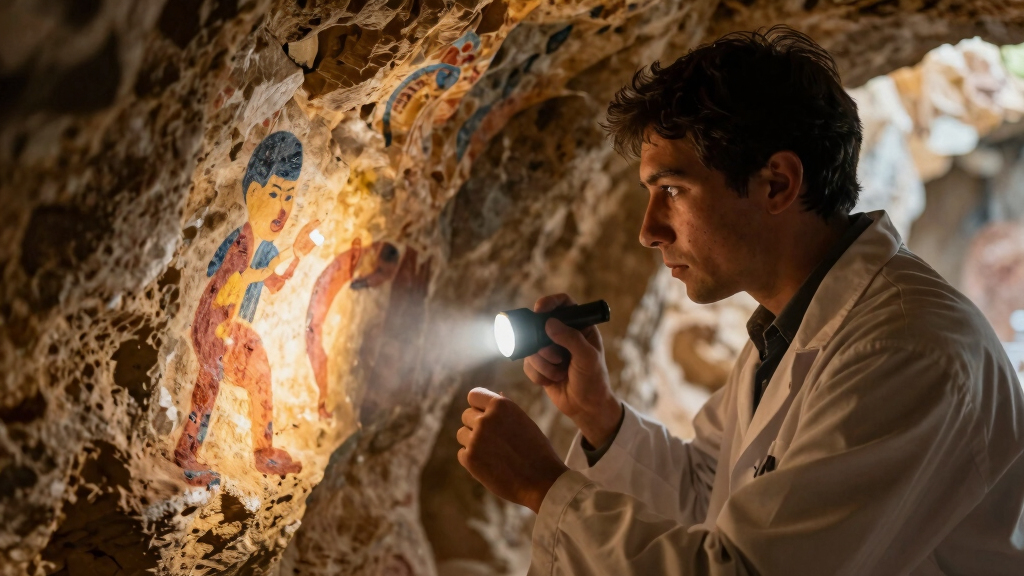
Scientists have discovered that human DNA can survive within pigments on cave walls for over 40,000 years. This breakthrough allows researchers to potentially identify ancient artists and better understand prehistoric communities.
Scientists have confirmed that human DNA can survive within pigments on cave walls for over 40,000 years. This discovery, made through analysis of samples from caves in Spain and Portugal, offers a new method for identifying ancient Paleolithic artists and understanding early human communities. The research, published in Nature Communications, marks a significant advance in archaeogenetics and cave art studies.
The study examined pigment samples from 24 rock art panels across 11 caves in Spain and Portugal, including notable sites like the Cave of Altamira and Maltravieso Cave. Human DNA was identified in some samples, particularly in hand stencils and figurative paintings, although the amount of DNA varied. Researchers noted that despite limited detection, the diversity of rock art techniques suggests other sites and styles could yield more genetic material in future studies.
This breakthrough was achieved by extracting and sequencing DNA from pigment residues, demonstrating that DNA can persist for thousands of years in mineral-bound pigments. The findings open potential for recovering identities of prehistoric artists, a task previously limited to analyzing bones, teeth, or faunal remains. The study’s lead researcher, from the Max Planck Institute, emphasized that this method could extend to caves outside Europe, such as the famous Cueva de las Manos in Argentina, which features hundreds of handprints dating back 13,000 years.
Implications for Identifying Paleolithic Artists
This discovery is significant because it introduces a new avenue for uncovering the identities of ancient cave painters beyond traditional archaeological methods. By retrieving human DNA directly from pigment residues, scientists can potentially link artworks to specific individuals or populations, providing insights into migration, social organization, and cultural practices of early humans. This method enhances our understanding of prehistoric life and the biological connections within ancient communities.
DNA extraction kits for ancient samples
As an affiliate, we earn on qualifying purchases.
As an affiliate, we earn on qualifying purchases.
Advances in Archaeogenetics and Cave Art Research
Previous research in archaeogenetics has primarily relied on analyzing skeletal remains, such as bones and teeth, to reconstruct ancient human history. The current findings build on this by demonstrating that artworks themselves are biological archives. The study is part of the larger First-Art project, involving international collaboration among archaeologists, geologists, and scientists from several countries. Historically, cave paintings like those at Altamira, dating to the Upper Paleolithic period (c. 40,000–10,000 years BCE), have provided visual records of early human expression but lacked direct links to individual artists.
This new technique could revolutionize the field, especially for sites where skeletal remains are absent or scarce, by offering a direct connection to the artists through their biological signatures.
“Retrieving molecular evidence of the past—whether of humans or the lifeforms they interacted with—has been revolutionizing our understanding of migration, pandemics, and cultural practices.”
— an anonymous researcher
As an affiliate, we earn on qualifying purchases.
Limitations and Future Potential of DNA in Cave Art
While the discovery confirms that human DNA can survive in cave pigments, the amount of recoverable DNA remains limited, and it is not yet clear how widespread or consistent this preservation is across different sites and styles. Researchers acknowledge that further studies are needed to determine the best techniques for extracting and analyzing ancient DNA from rock art, and whether this method can reliably identify individual artists or populations in all cases.
archaeological sample collection kits
As an affiliate, we earn on qualifying purchases.
As an affiliate, we earn on qualifying purchases.
Next Steps in Archaeogenetic Cave Art Research
Future research will focus on refining DNA extraction methods, expanding sampling across more caves and regions, and developing databases to match genetic profiles with known populations. Scientists also plan to investigate other types of pigment residues and explore the potential for identifying specific individuals or groups who created the artwork. This ongoing work aims to deepen our understanding of prehistoric cultural and biological histories.
As an affiliate, we earn on qualifying purchases.
Key Questions
Can human DNA in cave paintings identify the artist?
While the discovery suggests potential, it is not yet certain if enough DNA can be recovered to identify specific individuals. Further research is needed to determine the accuracy of this method.
Does the preservation of DNA vary across different caves?
Yes, preservation depends on factors like mineral composition, environmental conditions, and the age of the artwork. More studies are required to assess consistency across sites.
Could this method be used to study other ancient artworks?
Potentially, yes. The technique could be applied to other prehistoric art forms, such as paintings in caves outside Europe, if sufficient DNA is preserved.
What are the limitations of extracting DNA from cave art?
Limitations include the small amount of DNA recoverable, contamination risks, and the difficulty in linking DNA to specific individuals without additional genetic data.
When will this technique be widely used in archaeology?
It is still in early stages, but with ongoing refinement, it could become a standard tool within the next few years for studying prehistoric art and populations.
Source: rss
Halloween Picks
halloween
As an affiliate, we earn on qualifying purchases.