
TL;DR

Get furniture and decor delivered free — and shop member deals
- Fast, free delivery on millions of items
- Access to Prime Big Deal Days deals on October 6–7
- Prime Video, Amazon Music and more included
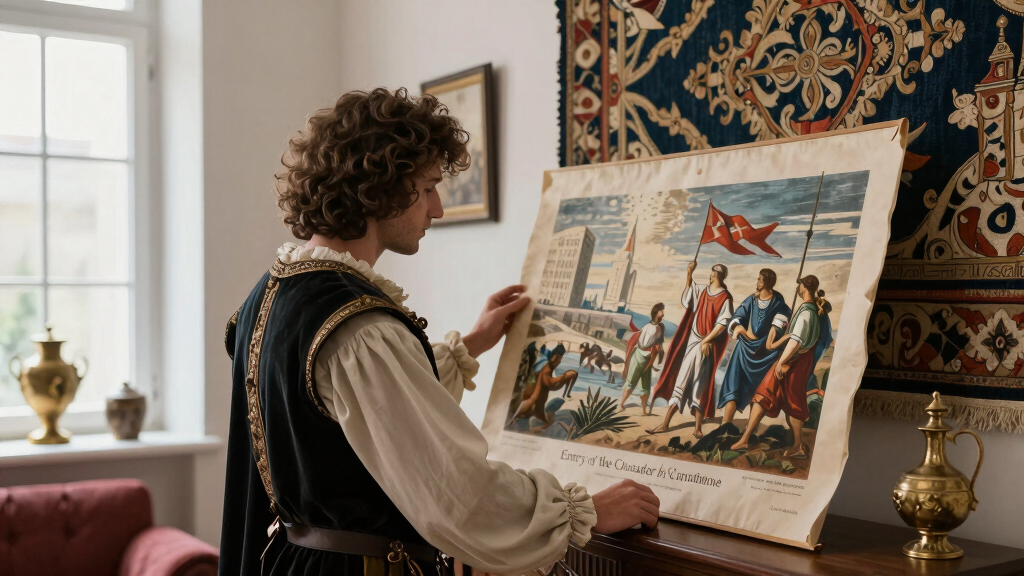
Eugène Delacroix’s ‘Entry of the Crusaders into Constantinople’ has been fully restored after conservation work. The painting, originally created in 1840, now displays its vivid colors and details as intended by the artist. The work’s restoration highlights its significance in art history and its recent return to public display.
The Louvre has completed a comprehensive conservation of Eugène Delacroix’s ‘Entry of the Crusaders into Constantinople,’ restoring its original colors and details, and has reinstalled it in the Red Rooms for public viewing. The work’s restoration underscores its importance as a major piece of 19th-century history painting and Delacroix’s artistic mastery.
The painting, created in 1840 and commissioned by King Louis-Philippe I, depicts the violent sack of Constantinople in 1204 during the Fourth Crusade. Over the years, the artwork’s varnish darkened, obscuring Delacroix’s vivid color palette. Conservation efforts, completed between May 2025 and April 2026, included removing the yellowed varnish, reinforcing the canvas, and applying a new transparent varnish. Scientific imaging revealed Delacroix’s detailed depiction of violence and suffering, including the plight of enslaved women and fallen soldiers, which had been obscured by previous restorations.
The restoration process involved meticulous cleaning, structural reinforcement, and digital radiography, which uncovered original brushwork and color effects. The conservators aimed to bring the painting’s visual impact closer to what Delacroix intended, highlighting his mastery of color and depth, especially in flesh tones and background landscapes. The restored work now stands as a vivid testament to the artist’s technical skill and historical narrative.
Why It Matters
The restoration of Delacroix’s ‘Entry of the Crusaders into Constantinople’ restores an important cultural and historical artifact to its original visual impact, allowing viewers to better understand Delacroix’s artistic techniques and the violent history it depicts. It also emphasizes the importance of conservation efforts in preserving national treasures for future generations, reinforcing the Louvre’s role as a guardian of art history.

Lineco Neutral pH Adhesive, Acid Free All-purpose Glue, White, 8 OZ, 1 Pack
- Acid-free, neutral pH adhesive: Acid-free, neutral pH formula
- Fast-setting, water-remoistenable: Quick-drying, reactivates with water
- Suitable for various crafts: Ideal for bookbinding and paper art
As an affiliate, we earn on qualifying purchases.
As an affiliate, we earn on qualifying purchases.
Background
The painting was initially displayed at the 1841 Paris Salon and later moved to the Château de Versailles’ neo-Gothic Crusades Rooms. It was transferred to the Louvre in 1881 due to its artistic significance. Over time, varnish yellowed and darkened the work, prompting conservation efforts that began in 2019. The recent treatment marks the culmination of a years-long campaign to preserve Delacroix’s large-format works, supported by notable benefactors.
“The meticulous conservation has revealed the vivid colors and complex details that Delacroix originally intended, providing new insight into his mastery of color and composition.”
— an anonymous researcher
“This restoration allows visitors to experience the painting as Delacroix envisioned, highlighting its significance in both art history and historical representation.”
— a Louvre spokesperson
As an affiliate, we earn on qualifying purchases.
What Remains Unclear
It is not yet clear if further technical analysis will reveal additional details about Delacroix’s original techniques or if future restorations might be needed to preserve the work further.
As an affiliate, we earn on qualifying purchases.
What’s Next
The Louvre plans to include the restored ‘Entry of the Crusaders into Constantinople’ in upcoming exhibitions and educational programs. Further research may be conducted to deepen understanding of Delacroix’s techniques, and ongoing preservation efforts will monitor the painting’s condition.
art conservation magnifying glass
As an affiliate, we earn on qualifying purchases.
As an affiliate, we earn on qualifying purchases.
Key Questions
What was involved in the conservation process?
The conservation included cleaning the varnish, reinforcing the canvas, filling in gaps, and applying a new protective varnish. Scientific imaging and digital radiography helped reveal original details.
Why was the painting darkened over time?
The darkening was caused by yellowed varnish and accumulated grime from years of exposure, obscuring Delacroix’s original colors and details.
Where is the painting now displayed?
It has been reinstalled in the Red Rooms of the Louvre, where it can be viewed by the public.
Will the painting be part of future exhibitions?
Yes, the Louvre plans to include it in upcoming exhibitions and educational programs to highlight its historical and artistic significance.
Source: Hacker News
Fall Picks
fall essentials
As an affiliate, we earn on qualifying purchases.