
TL;DR

Get furniture and decor delivered free with Prime
- Fast, free delivery on millions of items
- Prime Video, Amazon Music and more included
- Member-only deals all year
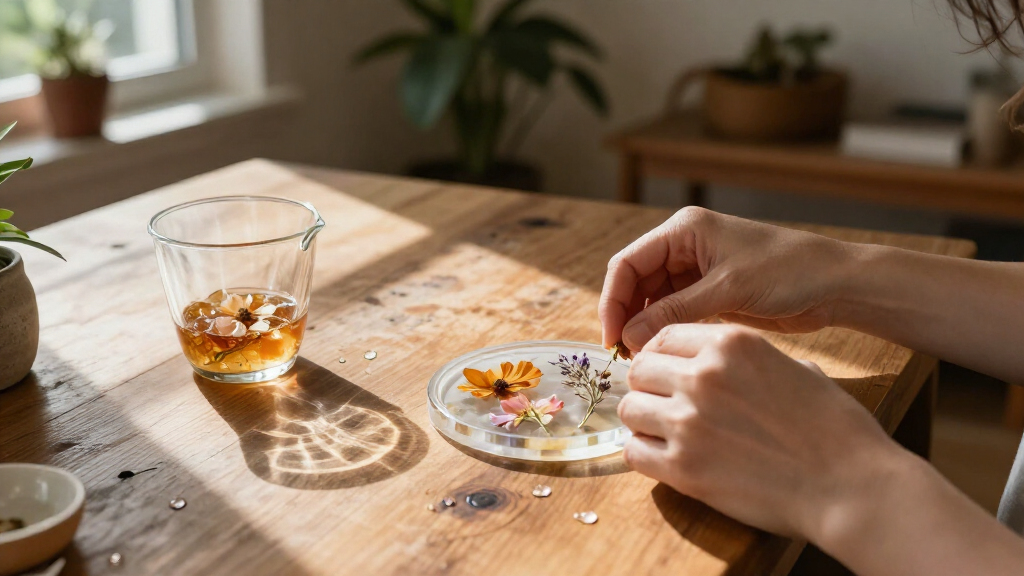
A Livingetc report describes a renewed interest in floral epoxy resin, with preserved blooms appearing in furniture, lighting and hospitality interiors. The style has historical roots in the 1940s and returned in the 1980s; designers and creative consultants say its appeal includes nostalgia and the idea of holding a moment in time.
Preserved flowers set in resin are appearing in a range of recent design projects, from a Paris herbal infusion house to tables and lighting by contemporary makers, according to a Livingetc report. The coverage frames the material as a renewed interior-design style, connecting its current use to nostalgia and a desire to preserve natural forms.
At Apoticari’s La Tisanerie, a herbal infusion house that opened in Paris’s Haut-Marais in September, a floral-enriched resin bar counter reinforces the venue’s botanical theme. The report describes the business as Paris’s first dedicated herbal infusion house. It also points to resin furniture and lighting elsewhere, including the Gelo side tables made by Monologue and Paraforma, and work by designers Sabine Marcelis and Laurids Gallée.
Romain Casella, founder and director of the London- and Geneva-based creative agency MAY, told Livingetc that nostalgia is part of resin’s appeal. He compared flowers enclosed in the material to the mosquito preserved in amber in the film Jurassic Park, saying the objects hold time still. Casella also highlighted resin’s use in tables, consoles and lighting, pieces intended to sit in everyday interiors.
The report says floral epoxy furniture originated in the 1940s and was revived in the 1980s. It identifies a current return alongside interest in amber-toned design, while citing Livingetc’s Style Pulse S/S27 report, which named “One Decorative Gesture” among design trends expected to influence interiors in the year ahead. Those are editorial assessments, not evidence of a measured market-wide rise.
Why Designers Are Preserving Flowers
The renewed visibility of floral resin matters because it brings natural material into furniture and fixtures in a way that changes how viewers encounter it. Rather than using flowers only as temporary decoration, designers place them within durable objects, where their color and form become part of a table, counter or light. The technique can make a botanical motif function as both visual decoration and a record of a particular material or moment.
Casella’s comments offer one explanation for that appeal: the wish to hold something still can feel reassuring amid uncertainty. That is his interpretation, not a proven account of why consumers or designers are choosing the material. The examples in the report show the style across hospitality and collectible design, but do not establish how widely it is being adopted or how long the interest will last.
Products Worth Considering

Bose SoundLink Flex (2nd Gen) Portable Bluetooth Speaker, Black

Shark Rocket Corded Stick Vacuum for Carpet and Hard Floors, Gray/Orange, HV301

Arlo Pro Wireless Security Camera, 2K HDR, 6th Generation, 4-Camera Kit
As an affiliate, we earn on qualifying purchases.
A Style With Earlier Lives
Floral resin is not a new technique. Livingetc traces the furniture genre to the 1940s, followed by a revival in the 1980s. Its appearance in current projects therefore represents a renewed use of an existing design approach, rather than the invention of a new material trend.
The report also places the work within a broader interest in amber colors and what it calls a “One Decorative Gesture” approach. Marcin Rusak, a Polish botanical artist and designer, describes flowers as potential carriers of knowledge, memories and emotions. He is due to present works including Flora Herbarium Clear Amber 152 at Salon Art + Design in New York, scheduled for November 4-8 at the Park Avenue Armory.
““Like the mosquito in amber in Jurassic Park, we’re deliberately choosing to freeze time — and there’s something reassuring in that in such unstable times: it doesn’t move; it’s there, still.””
— Romain Casella, founder and director of MAY, speaking to Livingetc
How Broad Is the Resurgence?
The report provides examples and designer commentary, but no sales figures, production data or consumer research to show the scale of demand. It is not clear whether floral resin is gaining traction across the wider interiors market or mainly appearing in selected hospitality and collectible-design projects. The claim that the style is “everywhere” reflects the report’s observations, not a quantified survey.
Details about the longevity, maintenance and environmental impact of the specific resin pieces are also not supplied. The article does not establish whether the flowers are locally sourced, how they are prepared, or how the resin is produced. Those points may vary by maker and product.
Upcoming Design Showings
The next dated event identified in the report is Salon Art + Design, scheduled for November 4-8, 2026, at New York’s Park Avenue Armory, where Rusak is expected to present botanical works including Flora Herbarium Clear Amber 152. The report also notes that Sabine Marcelis’s first solo museum exhibition, “Sabine Marcelis: Light and Color,” is scheduled at Zurich’s Museum für Gestaltung from October 30, 2026, to April 4, 2027.
These presentations may offer further examples of how designers are using resin and preserved forms. Whether the renewed attention turns into a broader, sustained interiors trend remains to be seen; the source does not provide a forecast supported by market data.
Key Questions
What is floral resin?
Floral resin is a design technique in which flowers or other botanical material are embedded in resin, often as part of furniture, counters or lighting. The Livingetc report focuses on epoxy resin pieces.
Where is the technique appearing in the report?
Examples include the resin bar counter at Apoticari’s La Tisanerie in Paris, Monologue x Paraforma’s Gelo side tables, and work by designers Sabine Marcelis and Laurids Gallée.
Is floral resin a new design trend?
No. Livingetc says the furniture style has roots in the 1940s and was revived in the 1980s. The current report describes renewed attention to it, rather than a newly invented technique.
Is there evidence that floral resin is becoming popular across the market?
The source points to several projects and designer observations, but gives no sales data or market-wide survey. The scale of the renewed interest is not established.
Source: livingetc.com